Nederlands
Professional DAW Plugins: A Guide to Building an Expert Studio Ecosystem in 2026
The difference between a cluttered VST folder and a high-performance studio ecosystem isn’t the number of licenses you own; it’s how your system handles the load under pressure. Many producers find themselves paralyzed by choice or sidelined by CPU overloads just as a session hits its creative peak. If you’ve ever struggled with complex iLok configurations or felt overwhelmed by the sheer volume of available professionele DAW plugins, you know that more tools rarely mean better results. A true professional rig prioritizes stability and specialized utility over sheer quantity.
We understand that your time is best spent on the mix, not troubleshooting software conflicts. This guide provides a methodical approach to selecting, optimizing, and managing high-end assets to transform your production workflow into a professional-grade environment. You’ll learn how to integrate industry standards like the Sonnox Vocal Production Bundle and Vienna Ensemble Pro 8 into a stable, high-performance rig. We will examine efficient asset management, licensing strategies for 2026, and the specific tools required to achieve elite results without compromising your system’s integrity.
Key Takeaways
- Identify the transition from creative VSTs to high-precision engineering tools to establish a predictable and reliable studio standard.
- Organize your production environment into logical categories like dynamics and instruments to create a streamlined, workhorse-driven template.
- Resolve critical system bottlenecks by implementing advanced processing strategies, including offloading heavy CPU loads to secondary machines.
- Simplify the administrative complexity of professionele DAW plugins by adopting a structured approach to iLok and cloud-based license management.
- Utilize expert-led procurement to ensure your software selections align with your specific technical requirements and administrative workflow.
What Defines Professionele DAW Plugins in a Modern Studio?
Professional DAW plugins are high-precision tools designed for rigorous signal processing and sound generation. In an expert studio environment, these tools act as the primary engineering standards rather than mere creative accessories. The industry has seen a clear shift where professionele DAW plugins from manufacturers like Sonnox or Waves have become the baseline for technical reliability. While entry-level VSTs focus on aesthetic presets, professional-grade software prioritizes algorithm transparency and bit-depth integrity. This technical foundation ensures that every processing decision remains predictable across different monitoring environments.
Top-tier studios move beyond stock plugins to achieve superior headroom and specific sonic characteristics. Integrated DAW effects are often designed to be CPU-efficient for the average user, which sometimes results in compromised oversampling or simplified math. Professional alternatives provide the resolution necessary for complex mixing and mastering tasks where every decibel of dynamic range matters. For a foundational understanding of these technologies, this audio plug-in overview details the evolution of the formats used in modern production.
The Difference Between Consumer VSTs and Professional Standards
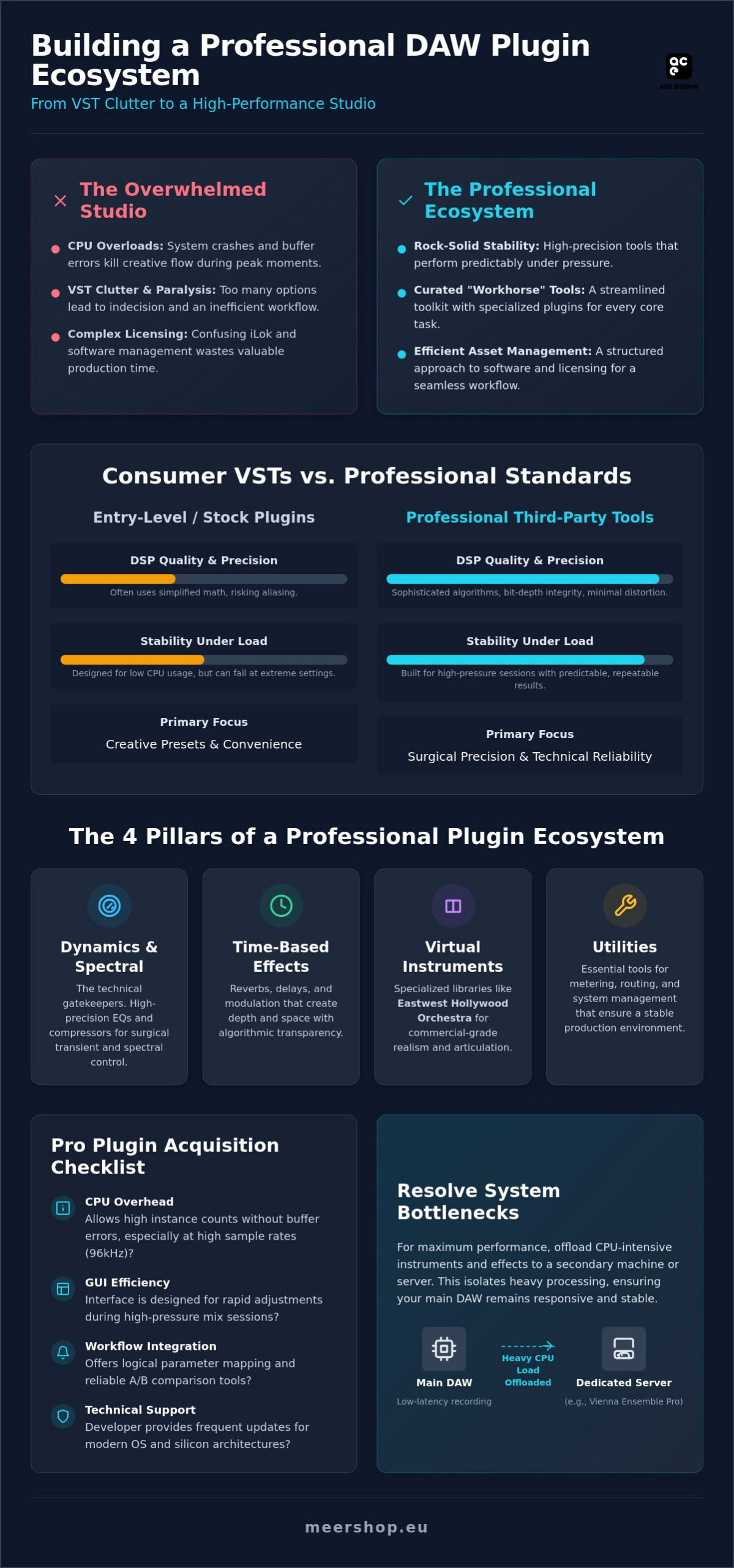
Digital Signal Processing (DSP) quality is the primary differentiator. Professional plugins utilize sophisticated algorithms that minimize aliasing and phase distortion, even when pushed to extreme settings. High-end tools also offer deeper hardware-software integration, allowing for tactile control that mirrors traditional analog workflows. Industry standards like the Sonnox Vocal Production Bundle are ubiquitous in elite studios because they provide a level of surgical precision that consumer-grade tools cannot replicate. When a deadline is tight, engineers rely on these tools for their stability and the manufacturer’s commitment to long-term software support.
Why Professional Engineers Invest in Third-Party Tools
The debate over stock plugins often centers on convenience versus quality. Built-in DAW tools frequently fail when tasked with high-end limiting or achieving true orchestral realism. A professional plugin is a tool that offers predictable, repeatable results in high-pressure environments. Engineers require specialized libraries, such as the Eastwest Hollywood Orchestra Opus Edition, to access the depth of articulation and sample quality needed for commercial film and broadcast work. Investing in third-party professionele DAW plugins isn’t about collecting more options; it’s about securing a toolkit that performs consistently under the most demanding technical requirements.
Essential Categories for a Professional Plugin Ecosystem
Building a professional studio rig requires a categorical approach to software acquisition. You should organize your toolkit into four primary pillars: Dynamics, Time-based Effects, Virtual Instruments, and Utilities. Identifying “workhorse” plugins for your project templates is essential for maintaining a high-speed workflow. These are the tools that appear on every channel strip, providing the foundational sound before any creative processing begins.
In-the-box (ITB) mixing efficiency depends on the quality of your professionele DAW plugins. High-end tools allow you to achieve the depth and separation typically associated with analog consoles without leaving your digital environment. Before adding a new tool to your ecosystem, use this systematic checklist to avoid session instability:
- CPU Overhead: Does the plugin allow for high instance counts without causing buffer errors at 96kHz?
- GUI Efficiency: Is the interface designed for fast adjustments during high-pressure sessions?
- Workflow Integration: Does it offer logical parameter mapping and reliable A/B comparison tools?
- Technical Support: Does the developer provide frequent updates for modern operating systems and silicon architectures?
Dynamics and Spectral Processing
EQ and compression are the technical gatekeepers of any mix. You need professional-grade tools to manage transient response and spectral balance with surgical precision. Specialized vocal processing is particularly critical in modern production to ensure clarity without introducing audible artifacts. For complex signal paths and advanced dynamics routing, a Pro Tools Ultimate 1 Year Subscription serves as the industry-standard backbone, offering the track count and internal architecture required for large-scale professional sessions.
Virtual Instruments and Orchestral Libraries
Professional virtual instruments are divided between synthesizers and high-end sample libraries. While synthesizers provide sound generation, sample libraries offer hyper-realistic recreations of acoustic environments. For those requiring authentic hardware emulations, the Vintage Vault UVI delivers a comprehensive collection of classic synth sounds with modern stability. Running massive libraries like the Saecula Organ Collection requires significant RAM and fast NVMe storage to handle the high-resolution multi-samples. Selecting the right professionele DAW plugins in this category ensures your productions maintain a competitive, commercial sound.
Improving CPU Efficiency and System Stability
The most frequent objection when scaling a studio rig is the concern that current hardware cannot handle additional processing loads. High-end production demands a high count of professionele DAW plugins, which can quickly lead to buffer errors and system crashes if not managed correctly. System stability is not just about raw CPU speed. It involves a calculated balance between buffer sizes, sample rates, and how your software interacts with the underlying hardware architecture.
Buffer sizes dictate the time your processor has to calculate audio data. While low buffers are essential for recording to minimize latency, they increase the risk of dropouts during mixing. Running sessions at 96kHz doubles the mathematical load on your CPU compared to 44.1kHz, making efficient plugin management mandatory. While “Freezing” tracks is a common workaround, it’s often a bottleneck in professional workflows because it locks your parameters and prevents real-time adjustments. A more robust solution involves offloading these tasks to dedicated hosting environments.
Network Rendering with Vienna Ensemble Pro
Integrating Vienna Ensemble Pro 8 into your workflow allows you to host heavy instruments and effects outside your primary DAW process. This software enables Vienna Ensemble Pro network rendering, which distributes the computational requirements across multiple machines via a standard LAN connection. Network rendering eliminates CPU bottlenecks by utilizing the RAM of slave computers. This setup ensures that your main workstation remains responsive, even when running massive orchestral templates or complex professionele DAW plugins that would otherwise stall a single machine. Composers who rely on the full Vienna Symphonic Library ecosystem should also consult this guide to VSL licensing and ecosystems from an authorized Vienna Symphonic Library reseller to ensure their Synchron Series libraries are correctly integrated and licensed for 2026.
Optimizing Your DAW for High Plugin Counts
Your choice of DAW and storage hardware significantly impacts how many active instances your system can sustain. Professionals often choose a Pro Tools Ultimate 1 Year Subscription for its superior voice count and reliable hardware integration, which is designed for high-track-count environments. Beyond the software, the role of SSD speed is critical. Using NVMe drives for sample library playback prevents disk I/O bottlenecks that can mirror CPU spikes. To maintain stability, organize your session templates to avoid redundant processing and ensure that your most demanding plugins are distributed logically across your system’s available threads.
Professional Audio Software License Management
Managing the administrative side of a studio is as critical as the engineering itself. In a professional environment, your professionele DAW plugins represent a significant financial and operational investment. Modern licensing typically falls into three categories: physical iLok dongles, cloud-based authorization, and machine-specific registration. Each method has distinct implications for session stability and mobility. Engineers must develop a systematic approach to handle these assets across multiple vendor portals, such as those for Waves, Sonnox, and VSL, to prevent downtime during high-pressure sessions.
A common failure point in digital asset management is relying solely on the manufacturer’s cloud for installers. You should maintain an offline backup of all plugin installers and license keys on a dedicated, redundant drive. This practice ensures you can rebuild a system in hours rather than days if a server goes offline or an internet connection fails. Using “cracked” or unauthorized software isn’t an option for any legitimate business. Beyond the legal implications, unauthorized software introduces significant malware risks and system instability that can corrupt project files and damage your professional reputation.
Best Practices for Studio License Security
Security protocols are essential for protecting your digital inventory. For a detailed breakdown of current standards, review this guide to professional audio software license management. Physical dongles remain the preferred choice for engineers who move between different studio facilities, as they allow for instant mobility without the need for constant internet authentication. While cloud licensing is convenient, it’s susceptible to local network outages. Subscription models, however, offer the advantage of ensuring your professionele DAW plugins remain compatible with the latest operating system updates and silicon architectures.
Managing Subscription vs. Perpetual Licenses
Deciding between buying software outright or paying an annual fee requires a long-term cost-benefit analysis. Perpetual licenses involve a higher upfront cost but offer long-term ownership, whereas subscriptions provide lower entry costs with continuous updates. When upgrading studio hardware, you must follow a strict de-authorization process to avoid “orphaned” licenses that are stuck on old machines. Be cautious of “Update Plan” traps; some manufacturers require ongoing fees to maintain compatibility with new DAW versions. Failing to manage these plans can lead to legacy sessions failing to open correctly, causing significant delays in archival work. For centralized procurement and license support, you can consult with a specialist at Meershop to audit your current software inventory.
The Meershop Advantage: Curated Tools for Audio Professionals
Meershop operates as a specialized resource for the Benelux audio market. Unlike general retailers that prioritize volume, we focus on providing high-precision tools for specific engineering requirements. Our pro-to-pro support model ensures you receive technical guidance from individuals who understand the administrative and operational complexities of modern studio software. Choosing between expansive bundles requires an understanding of DSP efficiency and license management that goes beyond a standard sales pitch. We act as an expert facilitator to ensure your investment in professionele DAW plugins aligns with your long-term technical goals.
Our expertise extends to the logistical nuances of the industry. We handle the administrative clarity needed for taxation, licensing tiers, and regional delivery methods, making the procurement process as efficient as possible. By positioning ourselves as a partner rather than a vendor, we help professionals maintain a reliable studio environment without the distraction of marketing fluff. Every tool in our catalog is selected for its utility and stability in high-pressure environments. This methodical approach ensures your software ecosystem remains functional as your hardware evolves over time.
Bridging the Gap Between Studio and Live Sound
The modern production landscape requires a seamless transition between the recording booth and the stage. The eMotion LV1 Classic serves as a primary bridge for engineers who want to utilize their studio processing chains in a live environment. This software-based console allows Waves plugins to integrate directly into the live signal path, providing a consistent sonic character regardless of the venue. Meershop is the primary resource for high-end audio software in the Netherlands. We provide the hardware and software integration necessary to make these hybrid setups stable and responsive under the pressures of live performance.
Expert Consultation for Your Next Upgrade
Transitioning from traditional hardware to software-based consoles requires a methodical approach to system design. Meershop assists engineers in auditing their current setups to identify bottlenecks and compatibility issues. We don’t just sell software; we provide a roadmap for long-term system stability. Whether you’re looking for mainstream industry standards or niche collections like the Saecula Organ anthology, we provide the technical precision needed to make an informed choice. Our team understands the specific requirements of the Benelux professional community, including hardware compatibility and local support needs. We invite you to browse the full catalog of professional DAW plugins at Meershop to find the exact professionele DAW plugins required for your next professional-grade upgrade.
Establishing a High-Performance Studio Standard
Maintaining a professional studio in 2026 requires more than just acquiring software. It demands a methodical approach to system stability, ranging from distributed processing with Vienna Ensemble Pro 8 to the administrative rigor of secure license management. By prioritizing high-precision engineering tools over an excessive quantity of VSTs, you ensure that your production environment remains stable and predictable under the most demanding session loads. Every processing decision should be based on technical reliability and sonic integrity to ensure consistent results across all monitoring environments.
As an authorized reseller for industry leaders like Sonnox, Vienna Symphonic Library, and Waves, Meershop provides the technical precision required for these complex ecosystems. We offer specialized support tailored for Benelux-based engineers and provide efficient digital delivery for most software licenses. This specialized authority helps you navigate the technical nuances of professionele DAW plugins without the distraction of marketing fluff. We’re here to act as an expert facilitator for your next technical upgrade, ensuring your tools match your expertise.
Explore our curated selection of professionele DAW plugins at Meershop and build a rig that performs as reliably as your hardware. Your studio deserves a foundation built on efficiency and expert-grade tools.
Frequently Asked Questions
What are the best professionele DAW plugins for vocal mixing?
The Sonnox Vocal Production Bundle is the industry standard for achieving commercial-grade vocal results. It provides a suite of specialized tools, including the Oxford DeEsser and VoxDoubler, which offer surgical precision without introducing audible artifacts. These tools are preferred by engineers who require high-end transparency and predictable results in high-pressure mix environments.
Do I need a physical iLok for most professional plugins in 2026?
You don’t strictly need a physical dongle, but it remains the most reliable method for professional mobility. Most developers now offer iLok Cloud or machine-based authorization as alternatives. However, a physical iLok USB protects you against internet outages and allows you to move your licenses between different studio facilities instantly without de-authorizing hardware.
Is it better to buy plugin bundles or individual licenses?
Bundles are generally more cost-effective when establishing the foundational pillars of your studio ecosystem. Collections like the Waves Diamond or Sonnox bundles provide essential dynamics and spectral tools at a lower per-unit cost. Individual licenses should be reserved for niche, high-precision tools that fill specific gaps in your workflow, such as specialized orchestral libraries.
How can I run more plugins without my DAW crashing?
The most effective way to increase your plugin count is to offload processing to a secondary machine using Vienna Ensemble Pro 8. This software manages the CPU and RAM load outside of your primary DAW’s process, preventing system overloads. Additionally, ensuring your sample libraries run from high-speed NVMe SSDs reduces disk I/O bottlenecks that often mimic CPU spikes.
Are third-party plugins better than the ones that come with Pro Tools?
Third-party professionele DAW plugins typically offer superior headroom and more sophisticated algorithms than standard stock effects. While Pro Tools stock plugins are efficient for basic tasks, professional alternatives from Waves or Sonnox provide better aliasing suppression and more musical saturation. These tools allow for deeper technical control during complex mixing and mastering stages.
Can I use my studio plugins for live sound mixing?
Yes, you can integrate your studio processing into a live environment using the eMotion LV1 Classic console. This system allows you to run Waves and other compatible plugins with low latency, providing a consistent sonic character between your studio recordings and live performances. It’s an essential bridge for engineers who require studio-grade precision on stage.
How do I manage licenses across multiple studio computers?
Centralized management is best achieved through the iLok License Manager or dedicated vendor portals like Waves Central. For studios with multiple workstations, using a physical iLok is the most efficient way to transfer professionele DAW plugins between rooms. Always maintain an administrative log of your account credentials and keep offline backups of your installers to ensure rapid recovery during hardware failures.
What is the best orchestral sample library for film scoring?
The Eastwest Hollywood Orchestra Opus Edition is widely considered the industry standard for commercial film and broadcast scoring. It offers an immense depth of articulation and multiple microphone positions, providing the realism required for professional soundtracks. Running this library effectively requires a robust system with significant RAM and high-speed storage to handle the high-resolution multi-samples.
YOU MIGHT ALSO LIKE