Nederlands
Eastwest Hollywood Orchestra Opus Edition: The Professional Buying Guide 2026
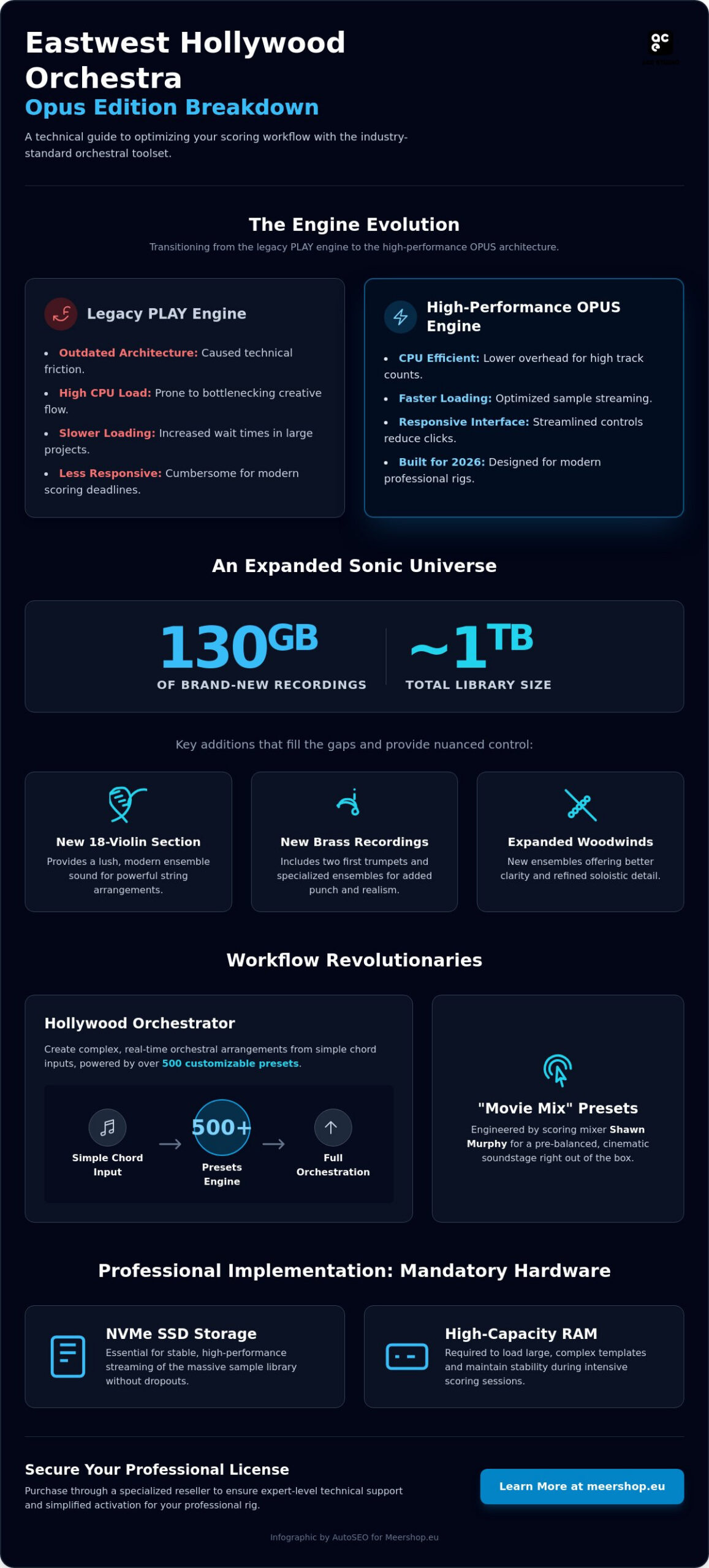
The transition from the legacy PLAY engine to the Eastwest Hollywood Orchestra Opus Edition represents a fundamental shift in how high-end orchestral mockups are managed and delivered. If your current scoring template relies on outdated architecture, you’re likely managing technical friction rather than composing. You already know that achieving a “blockbuster” cinematic sound usually requires hours of meticulous MIDI programming and a massive hardware footprint. It’s a common frustration for professionals who need to deliver studio-quality results under tight deadlines without their hardware bottlenecking the creative process.
This guide provides a technical and commercial breakdown of the Eastwest Hollywood Orchestra Opus Edition to help you optimize your scoring workflow and master the 130 GB of new content added in the latest version. We’ll examine the specific hardware requirements for the nearly 1TB library, compare the OPUS engine’s efficiency against its predecessor, and outline the most secure methods for securing a professional license. By analyzing the 500 customizable presets in the Hollywood Orchestrator and the latest v1.6.2 engine updates, you’ll gain the clarity needed to integrate this industry-standard tool into your professional rig.
Key Takeaways
- Understand the technical transition from the legacy PLAY engine to the high-performance OPUS engine for improved CPU efficiency and faster loading times.
- Master the Hollywood Orchestrator tool to create complex, real-time orchestral arrangements using over 500 customizable presets.
- Evaluate the specific content additions within the Eastwest Hollywood Orchestra Opus Edition, including the new 18-violin section and specialized woodwind ensembles.
- Identify mandatory hardware specifications, including the necessity of NVMe SSD storage and high-capacity RAM for stable professional scoring templates.
- Learn the advantages of securing a professional license through a specialized reseller to ensure expert-level technical support and simplified activation.
Understanding the Eastwest Hollywood Orchestra Opus Edition Ecosystem
The Eastwest Hollywood Orchestra Opus Edition is not a simple repackaging of legacy samples. It represents a total reconstruction of the industry’s most utilized orchestral toolset. While the original series defined the sound of modern media for over a decade, this edition introduces a structural overhaul designed for the 2026 production environment. The most significant technical shift is the transition from the aging PLAY engine to the new OPUS software architecture. This change isn’t just cosmetic; it provides a more responsive interface, faster loading times, and lower CPU overhead for high-track-count projects. It’s built for professional media composers who need a reliable, high-performance environment that delivers studio-quality results without constant troubleshooting.
At its core, the ecosystem now includes 130GB of brand-new recordings. These aren’t recycled takes. They are fresh captures designed to fill the gaps in the original library and provide more nuanced control over specific sections. For professionals, this means achieving a “blockbuster” sound out of the box, with less time spent on manual MIDI CC programming and more time spent on the composition itself.
What Makes the Opus Edition Different from Diamond?
The differences between the Diamond Edition and the Eastwest Hollywood Orchestra Opus Edition are primarily found in the expansion content and the integration of the Hollywood Orchestrator. The expansion packs add critical depth to the existing sections:
- Strings: A new 18-violin section that provides a lush, modern ensemble sound.
- Brass: New recordings for two first trumpets and specialized ensembles.
- Woodwinds: Expanded ensembles that offer better clarity and soloistic detail.
Another major differentiator is the “Movie Mix” technology. Developed by multi-Academy Award-winning scoring mixer Shawn Murphy, these presets provide a pre-balanced, cinematic soundstage. This allows you to toggle between different microphone configurations that Murphy specifically engineered for immediate use in film and game scores. Additionally, the Hollywood Orchestrator is now a core component of the software, allowing for complex rhythmic and melodic arrangements to be triggered by simple chord inputs.
The Legacy of the “Hollywood Sound”
The library’s sound signature is the result of a specific production team: Doug Rogers, Nick Phoenix, and Shawn Murphy. The recordings took place in Studio 1 at EastWest Studios, a room famous for its acoustic properties and history in major film score production. This environment contributes a natural “air” and depth that digital processing cannot replicate. Because the samples are recorded in the same space where many top-tier scores are tracked, they blend seamlessly with live orchestral overdubs. This synergy between the room acoustics and Murphy’s mixing expertise is why this library remains the beste orchestrale sample library for composers who require an authentic cinematic scale in their templates.
The OPUS Engine and Hollywood Orchestrator: Workflow Revolution
The OPUS engine is a ground-up replacement for the legacy PLAY system. It addresses the primary pain point of modern scoring: resource management. By optimizing how samples are purged and streamed from disk, the engine achieves significantly faster loading times and reduced CPU overhead. This efficiency allows you to maintain larger templates without hitting hardware limits. As noted in a detailed MusicRadar review of Hollywood Orchestra, the performance gains are particularly noticeable when running complex articulations on modern multi-core processors.
The refreshed interface prioritizes informational density. Visual instrument artwork is now high-resolution, and parameter controls are streamlined to reduce mouse clicks. You can manage multiple instruments within a single instance of OPUS, which simplifies the organization of your DAW’s track list. This structural change is critical for composers who need to switch between dry “Movie Mixes” and lush, ambient arrangements without reloading entire patches.
Mastering the Hollywood Orchestrator
The Hollywood Orchestrator functions as a MIDI-processing layer that sits between the keyboard and the sample engine. It uses a “Smart Analysis” algorithm to interpret chordal input and intelligently distribute notes across the various sections of the orchestra. This isn’t a simple arpeggiator; it understands the ranges and voicing of strings, brass, and woodwinds to create realistic arrangements instantly. The tool includes four distinct categories:
- Ensemble: Designed for quick orchestral sketches and full-range layering.
- Ostinato: Focused on rhythmic patterns and cinematic pulses.
- Score: Complete orchestral themes based on specific cinematic styles.
- User: A blank slate for building custom routing and rhythmic sequences.
With over 500 factory presets, you can achieve a polished sound immediately. However, the true value for professionals lies in the ability to modify these presets or build them from scratch to fit a specific project’s harmonic language.
UI and Performance Enhancements
The new “Instruments” tab provides immediate access to articulations, keyswitches, and microphone mixes without digging through sub-menus. This tab acts as a command center for each patch, allowing you to toggle specific techniques on or off to save RAM. Furthermore, the Eastwest Hollywood Orchestra Opus Edition supports high-resolution interface scaling for 4K and 5K professional monitors. This ensures that the text and controls remain legible even on high-density displays.
Managing complex templates is easier when the software handles the heavy lifting of note distribution and resource allocation. If you’re ready to upgrade your studio’s efficiency, you can find the Eastwest Hollywood Orchestra Opus Edition available for professional licensing. This streamlined workflow ensures that technical limitations don’t interrupt your creative momentum during high-pressure scoring sessions.
Evaluating the Orchestral Sections: From Strings to Percussion
The Eastwest Hollywood Orchestra Opus Edition organizes its massive sample pool into seven core libraries: Strings, Brass, Woodwinds, Percussion, Solo Violin, Solo Cello, and Solo Harp. While the original Hollywood series was celebrated for its “large” sound, the Opus expansion focuses on specific ensemble sizes that were previously missing. The new 18-violin section provides a lush, modern alternative to the original first violins, offering a smoother sustain that’s ideal for contemporary scoring. Similarly, the addition of two first trumpets and specialized woodwind ensembles allows for more precise melodic definition without the “phasing” issues often found when stacking smaller patches.
The Solo Harp and Solo Strings aren’t just decorative additions. In a professional mix, these instruments provide the necessary transient detail and “bow noise” that help a large ensemble arrangement feel grounded and realistic. While the ensembles provide the scale, the solo instruments provide the intimacy. The percussion section remains a standout for its versatility; it handles the aggressive, low-end impacts required for modern cinematic trailers while maintaining the delicate, traditional textures needed for standard orchestral work.
The Shawn Murphy Influence: Mic Positions and Mixes
The engineering behind these recordings is as critical as the performances. In the Diamond and Opus tiers, you have access to 13 distinct microphone positions. This level of control is essential for matching the virtual orchestra to different visual contexts. The “Movie Mix” presets, engineered by Shawn Murphy, provide an immediate professional balance that mimics the sound of a finished Hollywood dub stage. Composers can utilize the “Close” microphones for a dry, aggressive sound in modern hybrid scores or rely on the “Main” and “Mid” positions to capture the natural bloom of the recording space for more classical, traditional styles.
Articulation Depth and Realism
Realism in a virtual orchestra is defined by the transitions between notes. The Eastwest Hollywood Orchestra Opus Edition excels here with its “Legato Slur” and “Portamento” transitions. These articulations use actual recorded intervals to bridge notes, eliminating the “organ-like” feel of lesser libraries. The “Epic” brass patches are specifically programmed for high-velocity trailer music, providing a powerful, brassy “bite” that cuts through dense synth layers. Integrating these high-fidelity sounds into a virtual orchestra studio setup requires a balance of high-speed storage and organized keyswitching, but the result is a level of sonic authenticity that remains the industry benchmark.
Professional Implementation: System Requirements and Licensing
Implementing the Eastwest Hollywood Orchestra Opus Edition requires a realistic assessment of your workstation’s data throughput. While the minimum specifications suggest a quad-core processor and 16GB of RAM, these are insufficient for professional scoring workloads involving complex templates. The full library occupies 944GB of disk space. While standard SATA SSDs offer an improvement over mechanical drives, an NVMe SSD is mandatory for high-track-count projects. This is due to the sheer volume of data being streamed simultaneously when utilizing multiple microphone positions and detailed legato articulations. Without the multi-gigabyte-per-second read speeds of NVMe architecture, you’ll likely encounter audio dropouts or disk-read errors during playback.
For full orchestral templates where every section is pre-loaded, 64GB of RAM is the professional benchmark. This allows you to keep critical articulations in memory, reducing the need for constant purging and reloading. CPU optimization is equally vital for maintaining low latency. Modern DAWs like Pro Tools benefit from high core counts, as the OPUS engine is designed to distribute its processing load across multiple threads. An octa-core processor running at 2.7 GHz or higher is recommended to ensure the system remains responsive when the Hollywood Orchestrator is active.
Licensing is managed via the iLok system. You can authorize the software to a physical iLok USB dongle or directly to a machine license. In a professional studio environment where multiple workstations are used, the USB dongle remains the most flexible option for moving licenses between rooms without deactivation delays. A single synchronization error in your license manager can cost more in studio downtime than the software itself, which is why establishing a robust audio software license management strategy is a critical component of any professional scoring rig.
Hosting Opus in Vienna Ensemble Pro 8
To further stabilize your system, consider hosting the OPUS engine within Vienna Ensemble Pro 8. This allows you to offload the heavy sample processing to a secondary slave computer or simply run it as a background process on your primary machine. By doing so, you decouple the orchestral template from your DAW’s project file. This drastically reduces project save and load times, as the samples remain loaded in the background even when you switch between different scoring cues.
Digital Delivery and Activation
All software management is conducted through the EastWest Installation Center. This utility handles the 944GB download, product activation, and future library updates in a single interface. Securing your license through a specialized Eastwest reseller Nederland ensures you have access to reliable licensing support and technical troubleshooting. Whether you choose a perpetual license for long-term ownership or a subscription model for flexibility, ensure your hardware is ready for the technical demands of this library. You can explore professional licensing options for the Eastwest Hollywood Orchestra Opus Edition to ensure your studio is equipped with the latest orchestral technology.
Securing Your License: Why Professionals Buy from Meershop
Acquiring the Eastwest Hollywood Orchestra Opus Edition through a specialized reseller like Meershop offers distinct logistical advantages for European studios. While direct-to-manufacturer purchases are common, they often lack the localized support and administrative clarity required by professional entities in the Benelux and broader European markets. Meershop operates as an expert facilitator, providing a “pro-to-pro” environment that respects the technical requirements of high-end audio production. By focusing on a utilitarian and transparent transaction process, we ensure that you receive your digital license immediately, allowing your production schedule to remain on track without administrative delays.
One of the primary benefits of this partnership is the availability of professional support for complex installation queries. As discussed in previous sections, managing a library of nearly 1TB requires specific hardware configurations and licensing steps. Meershop understands these nuances and provides guidance that goes beyond simple sales. This expertise extends to a broader ecosystem of professional tools. Whether you are integrating your orchestral library with the Sonnox Vocal Production Bundle or the eMotion LV1 Classic mixing environment, we provide a centralized resource for the industry-standard software your rig requires.
The Meershop Advantage for Audio Professionals
Managing digital licenses for studio and stage use requires a reliable partner who understands the administrative needs of a business. Meershop provides VAT-compliant invoicing for all VAT-registered professionals and studios, which simplifies the procurement process for European companies. This transparency in pricing and documentation is essential for maintaining accurate business records. Additionally, our customers gain access to a curated catalog of the best software for film scoring. This selection ensures that every tool in your workstation, from the OPUS engine to your primary DAW, meets the highest professional standards.
Next Steps: Upgrading Your Scoring Rig
Transitioning from older libraries or the legacy PLAY engine to the modern Opus Edition environment is a significant step for any scoring rig. We offer consultations on system compatibility before purchase to ensure your hardware, specifically your NVMe storage and RAM capacity, is prepared for the 944GB library. This methodical approach prevents technical bottlenecks and ensures a seamless implementation into your current workflow. When you are ready to enhance your cinematic capabilities with the industry’s most comprehensive orchestral toolset, you can Purchase the Eastwest Hollywood Orchestra Opus Edition at Meershop. Our team is ready to facilitate your upgrade with the precision and reliability your professional studio demands.
Optimizing Your Professional Scoring Workflow
The Eastwest Hollywood Orchestra Opus Edition remains a definitive tool for media composers who require a balance of sonic scale and technical efficiency. By migrating to the high-performance OPUS engine, you gain the stability needed for massive orchestral templates while reducing CPU overhead. The integration of the Hollywood Orchestrator and Shawn Murphy’s specialized mixes ensures that your output meets modern cinematic standards with minimal technical friction. It’s essential to verify that your hardware, particularly your NVMe storage and RAM, is optimized for these high-throughput libraries to avoid performance bottlenecks during critical sessions.
As an authorized EastWest reseller, Meershop provides the specialized authority and technical support that professional audio engineers require. We offer transparent pricing and instant digital license delivery to keep your production schedule moving without administrative delays. Buy Eastwest Hollywood Orchestra Opus Edition at Meershop to secure your license from a partner that understands the nuances of professional scoring. Equip your studio with the industry’s most robust orchestral environment and focus on the creative composition itself.
Frequently Asked Questions
What is the total disk space required for the Hollywood Orchestra Opus Edition?
The Eastwest Hollywood Orchestra Opus Edition requires approximately 944GB of total disk space for a complete installation. This footprint includes the original Hollywood Orchestra content plus the 130GB of expansion recordings. Because of the high data throughput required for streaming these samples, an NVMe SSD is mandatory for professional stability. You can choose to download individual instruments or sections to manage storage if you don’t require the full orchestral palette immediately.
Do I need a physical iLok dongle to use Eastwest software in 2026?
You don’t need a physical iLok USB dongle to use Eastwest software in 2026. Licensing is managed via the iLok License Manager, which supports machine-based authorization directly to your workstation’s hard drive. However, many professionals still prefer the physical iLok USB Key for its portability. This allows you to move your licenses between different studio environments or mobile rigs without the need for constant deactivation and reactivation processes.
Can I upgrade to the Opus Edition if I already own the Hollywood Orchestra Diamond?
Owners of the legacy Hollywood Orchestra Diamond Edition can upgrade to the Opus Edition through a specific license transition. This upgrade provides access to the new OPUS software engine, the Hollywood Orchestrator tool, and the 130GB of expansion content. Upon purchasing the upgrade license, your existing Diamond samples remain compatible, but you’ll need to download the new recordings and the software engine to utilize the enhanced features and updated microphone mixes.
What are the minimum system requirements for the Hollywood Orchestrator engine?
The minimum requirements for the Hollywood Orchestrator engine include a quad-core processor running at 2.7 GHz and at least 16GB of RAM. However, for complex arrangements involving the full orchestra, an octa-core processor and 32GB or more of RAM are recommended. Because the Orchestrator processes MIDI data across multiple instrument instances simultaneously, your CPU must handle the real-time distribution of notes and articulation changes without introducing latency.
Is the Hollywood Orchestra Opus Edition compatible with Apple Silicon and Windows 11?
The Eastwest Hollywood Orchestra Opus Edition is fully compatible with Apple Silicon (M1, M2, M3 series) and Windows 11. The OPUS engine runs natively on ARM-based Mac systems, ensuring optimal performance without the need for Rosetta 2 translation. On Windows 11 systems, it requires ASIO sound drivers to maintain low-latency performance. Regular updates through the EastWest Installation Center ensure continued compatibility with the latest operating system security patches and architectural changes.
What is the difference between the Opus Edition and ComposerCloud+?
The primary difference lies in the ownership model and library access. The Opus Edition is a perpetual license that gives you permanent ownership of the orchestral library. In contrast, ComposerCloud+ is a subscription service that provides access to the Opus Edition along with over 43,000 other virtual instruments for a monthly or annual fee. Professionals often choose the perpetual license for their core templates to ensure project accessibility without ongoing subscription costs.
How many mic positions are included in the Opus Edition?
The Opus Edition includes 13 user-controllable microphone positions. These range from close-mic setups for high-definition detail to mid, main, and surround positions that capture the natural acoustic bloom of EastWest Studio 1. This depth allows you to build custom mixes or utilize the “Movie Mix” presets developed by Shawn Murphy. Having 13 positions provides the flexibility needed to match your virtual instruments to live orchestral recordings or dry hybrid scores.
Can I use the Hollywood Orchestra Opus Edition in a live performance setup?
You can use the Eastwest Hollywood Orchestra Opus Edition in a live performance setup, provided your hardware meets the recommended specifications for low-latency streaming. The OPUS engine’s improved efficiency and the Hollywood Orchestrator’s real-time arrangement capabilities make it a viable tool for live scoring or stage use. For maximum stability, it’s advisable to use a dedicated host like Vienna Ensemble Pro 8 for network-based sample hosting to manage the sample load outside of your primary performance software.
YOU MIGHT ALSO LIKE