Nederlands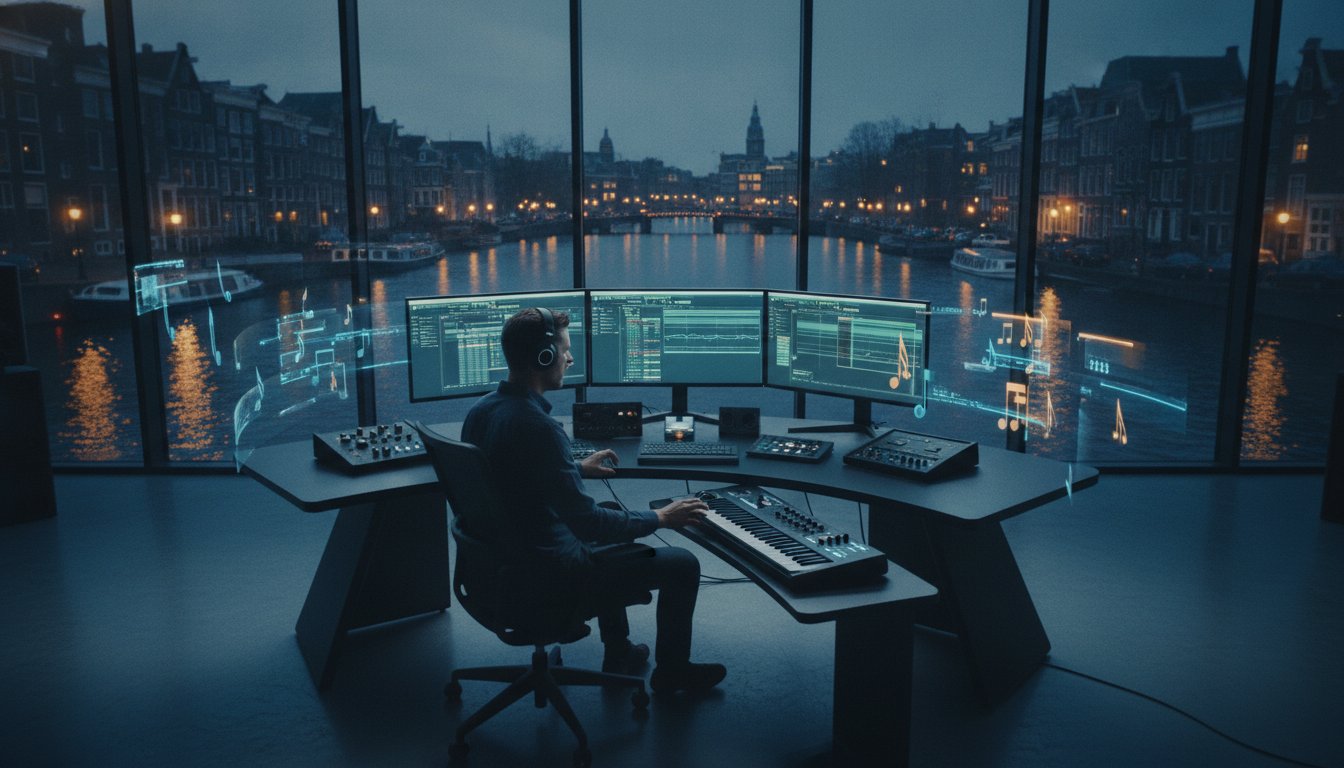
How to Build a Professional Virtual Orchestra Studio in 2026
In 2026, the primary bottleneck in film scoring isn’t your creativity; it’s the technical overhead of a poorly optimized virtual orchestra studio. High CPU usage and system crashes often interrupt the composition process, while unrealistic MIDI articulations can undermine the professional quality of a final mix. You have likely spent more time troubleshooting licensing or installation issues than actually writing music. These technical friction points don’t just waste time; they actively degrade the creative output of a professional production environment.
We understand that a stable, efficient workflow is non-negotiable when you’re working against tight production deadlines. This article outlines the essential steps and professional tools required to build a high-end orchestral environment that delivers photorealistic sound without compromising system stability. We will examine the hardware specifications necessary for modern libraries, the 37.2% market dominance of Pro Tools Ultimate, and the recent June 2026 updates to Vienna Ensemble Pro 8.1. You’ll learn how to integrate tools like the Eastwest Hollywood Orchestra Opus Edition to achieve a professional Hollywood sound while maintaining a lean, responsive system. By following this technical roadmap, you’ll establish a studio capable of handling the most demanding scores with clinical precision.
Key Takeaways
- Learn how to transition from basic MIDI mockups to photorealistic orchestral production using professional tools like the Eastwest Hollywood Orchestra Opus Edition.
- Understand the technical role of Vienna Ensemble Pro 8 in managing massive templates and preventing CPU-related system crashes.
- Evaluate the necessity of advanced video engine support and workflow speed when selecting a DAW for high-pressure film scoring environments.
- Establish a scalable implementation strategy for your virtual orchestra studio by prioritizing hardware benchmarks like RAM and SSD speed before acquiring new libraries.
What is a Professional Virtual Orchestra Studio?
A professional virtual orchestra studio is a specialized digital ecosystem that uses high-fidelity sample libraries and advanced processing tools to emulate the sound of a full symphony orchestra. While early digital music production relied on basic MIDI mockups that lacked nuance, 2026 production standards demand photorealistic results. This shift means that a composer’s digital output must capture the subtle bow noise of a cello or the complex resonance of a concert hall. Understanding What is a Virtual Orchestra? requires looking at the integration of hardware and software designed to handle massive data throughput.
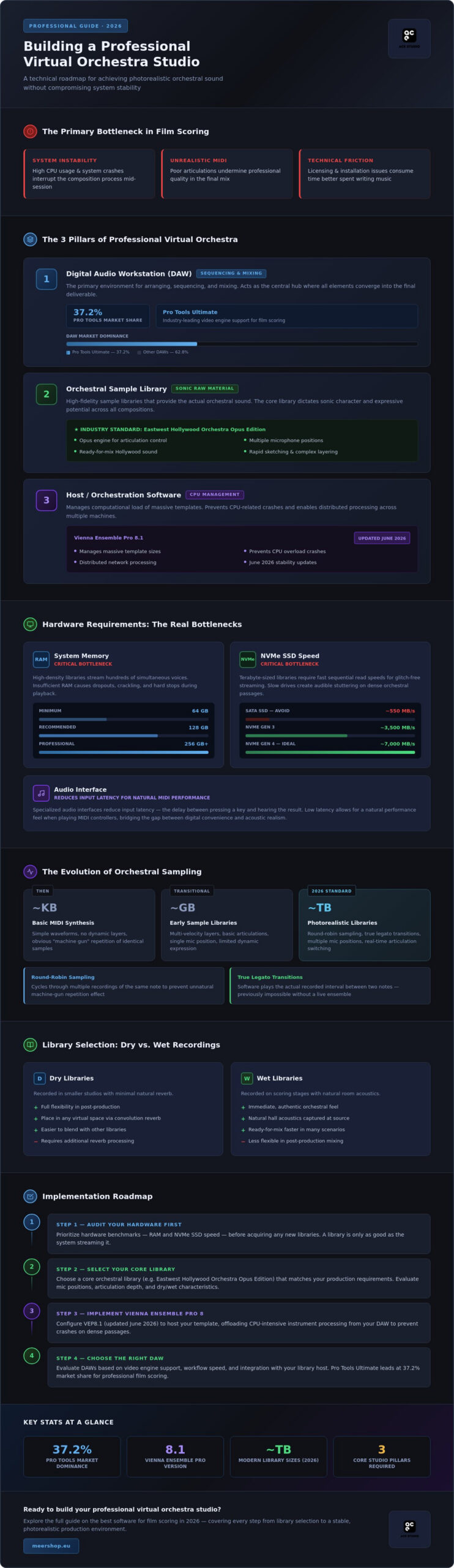
Modern scoring relies on three primary pillars. First, the Digital Audio Workstation (DAW), such as Pro Tools Ultimate, acts as the sequencing and mixing environment. Second, high-end sample libraries like the Eastwest Hollywood Orchestra Opus Edition provide the raw sonic material. Finally, host software like Vienna Ensemble Pro 8 manages the computational load. Professional-grade tools are now mandatory for film scoring and commercial work. They provide the dynamic range and articulation depth required by modern directors and music supervisors who expect studio-quality deliverables from the first demo.
The Evolution of Orchestral Sampling
Orchestral sampling has evolved from simple synthesis into terabyte-sized libraries utilizing multiple microphone positions. In 2026, technology allows for sophisticated round-robin sampling; this prevents the “machine gun effect” by cycling through different recordings of the same note. True legato transitions, where the software plays the actual recorded interval between two notes, are now standard. These advancements enable composers to perform complex orchestral passages in real-time with a level of expressive detail that was previously impossible without a live ensemble.
Software vs. Hardware Needs
System performance in a virtual orchestra studio typically hits bottlenecks at the RAM and SSD levels. High-density libraries stream hundreds of voices simultaneously. This makes NVMe SSD speeds and high RAM capacity essential for glitch-free playback. Specialized audio interfaces also play a critical role by reducing input latency, which allows for a more natural performance feel when playing MIDI controllers. A virtual orchestra serves as a professional production standard in 2026, bridging the gap between digital convenience and acoustic realism.
Step 1: Selecting Your Core Orchestral Library
Selecting a core library is the most critical decision when building a virtual orchestra studio. This library acts as your primary instrument. It dictates the sonic character and expressive potential of your compositions. While all-in-one bundles offer a cohesive sound across different sections, specialized libraries often provide greater articulation depth for solo instruments. Professionals must evaluate microphone positions and dynamic layers to ensure the digital output has cinematic depth. Effective Digital Orchestration in Media Compositions requires tools that respond accurately to MIDI data. This ensures the transition from a mockup to a final master is seamless. Your library selection must also align with the best software for film scoring to maintain a responsive workflow.
The Industry Standard: Eastwest Hollywood Orchestra Opus Edition
The Eastwest Hollywood Orchestra Opus Edition is a foundational asset for professional composers. Its Opus engine provides a high level of control over individual articulations and microphone mixes. This edition includes the “Opus” orchestration tool, which is designed for rapid sketching and complex layering. It allows you to build massive orchestral textures quickly without manually programming every MIDI lane. The library remains a staple because it offers a consistent, high-end sound that meets the rigorous demands of modern film and television production. It’s particularly effective for those who need a “Hollywood sound” that is ready for the mix immediately after sequencing.
Evaluating the Best Orchestral Sample Library for Your Needs
Choosing the right library involves deciding between dry and wet recordings. Dry libraries recorded in smaller studios offer more flexibility in post-production. You can place them in any virtual space using convolution reverb. Wet libraries recorded in scoring stages provide an immediate cinematic atmosphere, which is often preferred for tight deadlines. Consider these factors when evaluating your options:
- Articulation Depth: Ensure the library includes true legato, staccato, and various sustain options.
- Microphone Positions: Multiple mic perspectives (close, decca, surround) allow for precise control over the orchestral image.
- Niche Requirements: Specialized tools like the Saecula Organ Collection provide character that generic bundles cannot replicate.
You can find a detailed breakdown of these options in our beste orchestrale sample library guide. Prioritizing library quality over quantity ensures that your virtual orchestra studio delivers professional results from the start. You can find the Eastwest Hollywood Orchestra Opus Edition and other essential tools for your production environment at Meershop. For Dutch-based composers, sourcing these licenses through a dedicated Eastwest reseller Nederland ensures EU-compliant invoicing and eliminates the administrative friction of purchasing directly from US-based stores.
Step 2: Optimizing Performance with Vienna Ensemble Pro 8
Managing a professional virtual orchestra studio requires handling thousands of MIDI tracks and high-resolution samples simultaneously. This creates a significant risk of CPU overload within the primary DAW. Vienna Ensemble Pro 8 addresses this by acting as a dedicated host for virtual instruments, operating outside the primary DAW process. By June 2026, the software has matured into version 8.1.834, offering critical stability updates for Windows users and enhanced handling of video plugins. It remains the industry standard because it allows composers to build massive templates that stay loaded in the system RAM even when switching between different projects or cues.
This separation of the instrument host from the sequencing environment prevents the DAW from crashing during high-demand orchestral passages. The latest version also introduced a public beta for an MCP server, which enables integration with AI assistants to help manage complex routing and template organization. By offloading the heavy lifting of sample playback to this specialized host, you ensure that your creative process remains uninterrupted by technical bottlenecks.
Setting Up a Networked Studio Rig
To maximize performance, many professionals use a distributed processing model by connecting a primary workstation to a secondary “slave” PC via a high-speed Ethernet network. Vienna Ensemble Pro 8 manages this connection seamlessly without the need for additional audio interfaces on the slave machine. Audio and MIDI data are routed directly through the network cable into your primary DAW. This configuration allows the slave PC to handle the intensive sample streaming from libraries like the Eastwest Hollywood Orchestra Opus Edition, while your main workstation remains responsive for MIDI editing and video playback.
Template Management and Efficiency
Efficiency in a high-pressure scoring environment depends on a well-structured template that includes all orchestral sections. To manage hardware resources, you should utilize the “disable” feature within Vienna Ensemble Pro 8. This keeps tracks visible in your DAW but prevents them from consuming RAM or CPU cycles until they are activated for a specific cue. You can also use the “preserve” function to keep your entire orchestral palette loaded in the background. This eliminates the long wait times typically associated with opening large scoring projects. Vienna Ensemble Pro 8 is essential for 2026 workflows because it provides the scalable architecture needed to host massive, AI-integrated orchestral templates across multiple machines without taxing local system resources.
Step 3: Choosing the Right DAW for Orchestral Scoring
The Digital Audio Workstation (DAW) serves as the central hub of your virtual orchestra studio. While many platforms offer functional MIDI sequencing, the primary selection criteria for a professional environment should be workflow speed and stability under heavy track counts. Media composers require advanced video engine support to ensure sample-accurate synchronization with picture. For hybrid scores that incorporate vocal elements, integrating specialized mixing tools like the Sonnox Vocal Production Bundle is necessary to maintain professional clarity within a dense orchestral mix. The software’s ability to handle complex signal paths without introducing excessive latency is critical for meeting production deadlines.
Pro Tools Ultimate for Orchestral Post-Production
Pro Tools remains the industry standard for the final mixing and post-production stages of a film score. Market analysis from 2025 indicates that Pro Tools holds a dominant 37.2% share among professionally skewed audiences. This dominance is due to its robust handling of high track counts and the complex routing required for large-scale sessions. For studios managing annual budgets, the Pro Tools Ultimate 1 Year Subscription offers a predictable cost structure with access to the latest video and audio engine updates. This subscription model ensures your studio remains compatible with the delivery requirements of major post-production houses and scoring stages.
Expanding the Palette with Specialized Plugins
Modern scores often blend acoustic instruments with electronic textures to create a unique sonic signature. You can use Vintage Vault UVI to add hybrid orchestral-synth layers that provide harmonic depth. While most DAWs include functional stock plugins, professional environments often require third-party hardware emulations for specific harmonic characteristics. Finalizing a score requires professional-grade limiters and compressors to meet the loudness standards of streaming and theatrical releases. These tools provide the transparency needed to preserve the dynamic range of your orchestral libraries.
You can secure your Pro Tools Ultimate 1 Year Subscription and other professional production tools directly through Meershop to ensure your studio meets 2026 industry standards.
Implementing Your Virtual Orchestra Studio Strategy
Building a professional virtual orchestra studio requires a phased approach that prioritizes infrastructure over library quantity. A common error among composers is acquiring multiple high-end libraries without the hardware overhead to support them. You should start with a comprehensive core library, such as the Eastwest Hollywood Orchestra Opus Edition, and expand your collection only when a specific project demands a unique sonic signature. This methodical expansion prevents software bloat and ensures that every tool in your arsenal serves a practical purpose.
Just as technical infrastructure is vital, maintaining a healthy personal life is essential for long-term creative success; for professionals balancing a demanding career with family, De Relatiespecialist offers specialized relationship therapy for couples with children.
Hardware benchmarks are the foundation of this strategy. You must prioritize RAM and NVMe SSD upgrades before investing in additional sample content. High-density libraries in 2026 require massive throughput; a system bottleneck will lead to dropouts regardless of how expensive your software is. Additionally, a calibrated monitoring environment is essential. Without accurate acoustic treatment and speaker calibration, you cannot make informed decisions about the cinematic depth or frequency balance of your orchestral mix. Procuring your digital licenses through a specialized reseller ensures you receive professional support for complex installation and authorization processes. Netherlands-based professionals can streamline this process significantly by working with a local Eastwest reseller Nederland to handle VAT-compliant invoicing and instant digital delivery of high-end orchestral libraries.
If your studio vision requires more physical space than your current home allows, you can explore Projectgebaseerde aannemingssommen voor woninguitbreidingen to plan a high-end extension designed for professional audio work.
The Hybrid Studio: Integrating Live Sound and Virtual Tools
The most successful scores often blend virtual instruments with live recordings to humanize the digital environment. Tools like the eMotion LV1 Classic provide a versatile bridge between studio production and live recording sessions. By recording even a single live soloist to play the lead melody over a virtual mockup, you “breathe life” into the MIDI arrangement. This hybrid approach requires careful management of latency across your hardware and software setup. Using a dedicated host like Vienna Ensemble Pro 8 helps maintain a lean primary session, allowing you to track live instruments with minimal delay while your orchestral template remains active in the background.
Maintaining Your Professional Ecosystem
A virtual orchestra studio is a living system that requires regular maintenance to ensure 2026 compatibility. You should establish a schedule for updating your DAW and library engines to benefit from the latest stability patches and AI integration features. Maintaining an organized directory for your sample content and presets will save hours of technical troubleshooting during tight delivery windows. Meershop acts as an expert facilitator in this process, providing audio professionals with the technical precision and reliable tools needed to maintain a high-performance studio environment. Because maintaining your own physical stamina is just as vital as your technical setup, many professionals use high-quality magnesium from Magnesiumnu.nl to help manage the muscle tension and stress that can occur during long sessions. Our focus is on providing the administrative and logistical clarity you need to stay focused on the creative process.
Explore the professional audio catalog at Meershop to find the essential hardware and software for your production environment.
Optimizing Your Future Orchestral Production
Building a professional virtual orchestra studio in 2026 requires a precise balance of high-fidelity sound and technical efficiency. You’ve learned that offloading processing to Vienna Ensemble Pro 8 and selecting a core library like Eastwest Hollywood Orchestra Opus Edition are foundational steps. These tools, combined with the industry-standard routing of Pro Tools Ultimate, create a stable environment capable of meeting modern film scoring demands. Success depends on prioritizing hardware benchmarks like RAM and SSD throughput before expanding your library collection.
Meershop acts as your expert facilitator in this technical landscape. As an authorized reseller for Eastwest, Vienna Symphonic Library, and Sonnox, we provide specialized technical support for professional engineers. We ensure the efficient digital delivery of high-end software licenses; this allows you to focus on the creative process rather than administrative logistics. For educators and directors who need to manage their broader organization, you can explore Xperios for Music Services to handle the operational side of your practice. Our goal is to provide the reliability and technical precision your studio requires to remain competitive.
Upgrade your studio with professional audio tools at Meershop and establish a production environment that meets the highest industry standards. Your path to a photorealistic orchestral sound is now clearly defined.
Frequently Asked Questions
What is the best computer for a virtual orchestra studio?
High-performance workstations with at least 16 cores and 128GB of RAM are ideal for professional scoring. You should prioritize NVMe SSDs with read speeds exceeding 5,000 MB/s to handle simultaneous sample streaming from libraries like the Eastwest Hollywood Orchestra Opus Edition. While Apple Silicon Ultra chips offer excellent power efficiency, custom PC builds with Intel i9 processors remain popular for their PCIe expansion capabilities. The choice depends on your specific DAW requirements and the complexity of your orchestral templates.
Do I need a secondary computer for Vienna Ensemble Pro 8?
A secondary computer is not strictly necessary but provides a significant performance advantage for massive setups. Vienna Ensemble Pro 8 allows you to host instruments on the same machine to bypass DAW resource limits. However, using a slave PC via a Gigabit Ethernet connection effectively doubles your available RAM and CPU power. This distributed processing model is the standard for film composers managing templates with thousands of active tracks without taxing the primary workstation.
How much RAM is required for a professional orchestral template in 2026?
Professional orchestral templates in 2026 typically require a minimum of 128GB of RAM as a baseline. High-fidelity libraries often utilize multiple microphone positions and deep articulation layers, which consume memory quickly. While 64GB may suffice for smaller hybrid projects, a comprehensive virtual orchestra studio setup often scales toward 256GB to ensure glitch-free playback. Using the “disable” feature in your host software can help manage these requirements on systems with lower memory capacity.
Can I use a virtual orchestra for live performances?
You can use a virtual orchestra for live performance provided you have a low-latency hardware environment. Tools like the eMotion LV1 Classic are designed to integrate high-end software instruments into live sound workflows with high stability. Real-time reliability depends on setting a low buffer size, typically 128 samples or fewer, and using a dedicated audio interface. This allows keyboardists and conductors to trigger photorealistic orchestral sounds during live events without perceptible delay or system instability.
What is the difference between Eastwest Hollywood Orchestra and other libraries?
The Eastwest Hollywood Orchestra Opus Edition is distinguished by its specialized Opus engine and advanced orchestration tools. Unlike entry-level libraries, it offers a specific “Hollywood sound” recorded on a world-class scoring stage with extensive mic perspectives. The included orchestration tool allows for rapid sketching, which is a critical feature for professional composers working under tight deadlines. It provides a level of articulation depth and dynamic control that generic bundles often lack.
Is a subscription or a perpetual license better for Pro Tools?
A subscription model, such as the Pro Tools Ultimate 1 Year Subscription, is generally better for maintaining 2026 software compatibility. This ensures you always have the latest video engine updates and OS support, which are vital for professional post-production. Perpetual licenses often require separate support plans to stay current, whereas subscriptions provide a predictable annual cost with all features included. This model is preferred by studios that need to guarantee delivery compatibility with major production houses.
How do I reduce MIDI latency in my virtual studio?
Reducing MIDI latency requires a combination of high-speed audio drivers and optimized host settings. You should use a dedicated audio interface with stable ASIO or Core Audio drivers and set your DAW buffer to the lowest stable value. In a networked virtual orchestra studio, Vienna Ensemble Pro 8 manages latency compensation across the Ethernet connection. Ensuring your MIDI controller is connected via a high-speed USB or MIDI port also minimizes input delay during your performance recording.
Where can I buy professional audio software licenses in the Netherlands?
Meershop is a specialized reseller providing authorized digital delivery of professional audio licenses in the Netherlands and for the global market. We offer high-end software from manufacturers like Eastwest, Vienna Symphonic Library, and Sonnox with a focus on administrative clarity. Our platform is designed for audio professionals who require technical precision and reliable support for their studio investments. Every purchase includes the necessary documentation for business taxation and licensing compliance in the European market.