Nederlands
Best Orchestral Sample Library (Beste Orchestrale Sample Library): The 2026 Professional Guide
A high-fidelity sample library is a liability if it lacks the engine efficiency to sustain a complex scoring session. You’ve likely dealt with the frustration of inconsistent scripting across sections or RAM usage that pushes your hardware to its breaking point during a critical deadline. Finding the beste orchestrale sample library involves more than just listening to polished audio demos. It requires a clinical look at how the software integrates into a professional environment without causing system instability or licensing headaches.
This 2026 guide provides a technical and commercial comparison of the industry’s leading orchestral tools to help you build a high-performance scoring template. We’ll focus on reliability and workflow efficiency so you can spend more time composing and less time troubleshooting technical errors. You’ll gain insights into the latest software developments, including the Eastwest OPUS engine version 1.6.2 and the networking power of Vienna Ensemble Pro 8.1. We’ll examine how these tools scale with your career to ensure your studio remains future-proof and ready for any professional project demand.
Key Takeaways
- Learn how to identify the beste orchestrale sample library for your specific workflow by comparing genre-specific requirements for film, games, and pop production.
- Understand the technical benchmarks that define professional software, including round-robin scripting to prevent the machine gun effect and multi-mic position flexibility.
- Evaluate the performance of the Eastwest Hollywood Orchestra Opus Edition and its high-speed scoring capabilities through the Hollywood Orchestrator.
- Discover how to host massive templates and offload CPU processing using Vienna Ensemble Pro 8 to maintain a stable, high-performance DAW environment.
- Secure your professional studio investment by navigating complex iLok and manufacturer licensing through authorized reselling support.
Defining the “Beste Orchestrale Sample Library” for Your Workflow
The search for the beste orchestrale sample library is not a quest for the most expensive product, but for the tool that fits your specific delivery requirements. In a professional scoring environment, the “best” library is defined by its ability to produce a specific sound within a rigid deadline. A library that sounds magnificent in a film trailer might fail in a delicate chamber music context due to a lack of intimate detail or excessive hall ambience.
Modern libraries have transcended the limitations of early the technology of music sampling. By 2026, we’ve moved past simple multi-samples into the era of intelligent performance modeling. High-quality recordings are now the baseline; the real differentiator is how the library manages CPU resources and articulation switching under heavy loads. You need a tool that responds to your MIDI input as an instrument, not just a collection of static audio files.
You must decide between a “wet” library recorded in a scoring stage and a “dry” library recorded in a studio. Wet libraries offer instant cinematic gratification because the room’s natural reverb is baked into the samples. However, they can be difficult to place in a mix with other elements. Dry libraries require more work with external reverb but offer the precision needed for hybrid scores where you might blend orchestral textures with synths from collections like Vintage Vault UVI. This flexibility is often the deciding factor for composers working across multiple genres.
The engine is the heart of your daily creative flow. Whether you use the Eastwest Opus engine, SINE, or Kontakt, the software must handle thousands of voices without crashing. A library with beautiful samples is useless if its engine introduces latency or instability during a recording session. Efficiency in voice management and fast loading times are the metrics that define professional utility in a high-pressure studio. Building a reliable virtual orchestra studio around these principles is the foundation of any serious scoring workflow.
Genre-Specific Selection Criteria
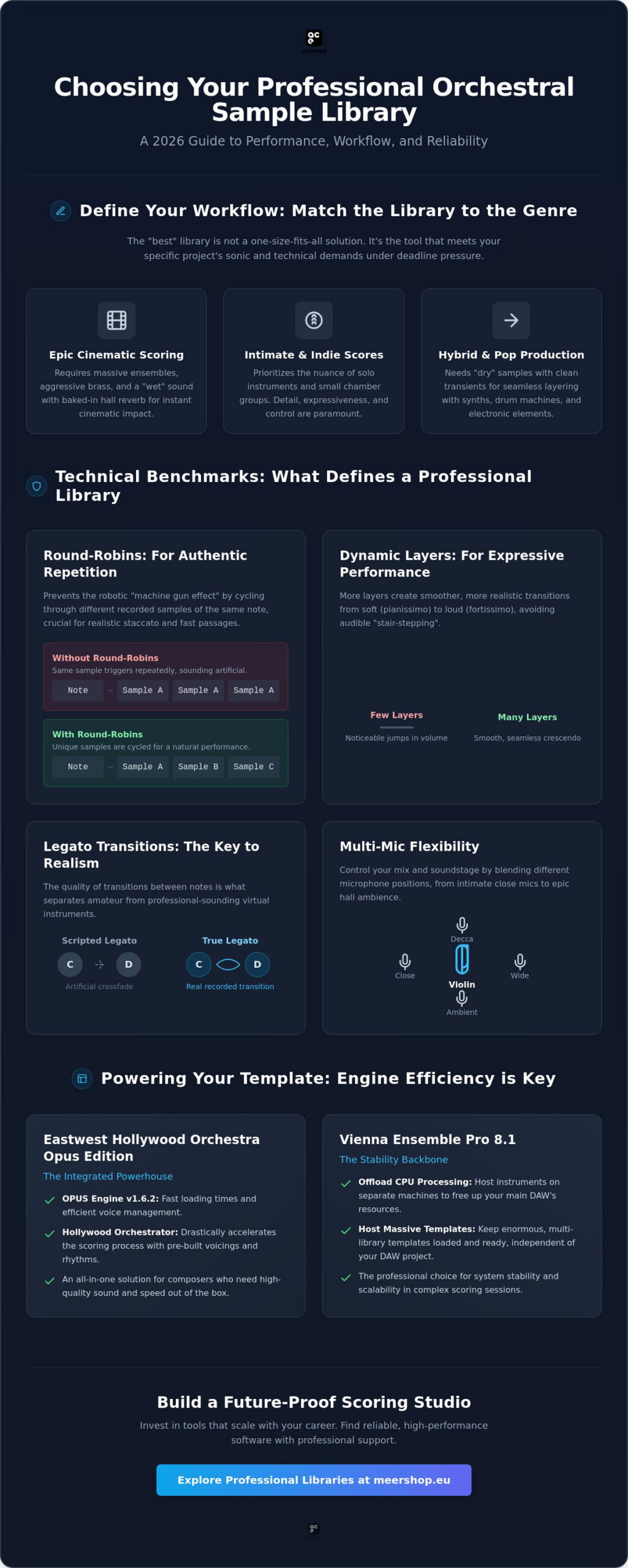
Epic cinematic scoring relies on massive ensembles and aggressive brass that can cut through a dense trailer mix. Intimate scores for indie films or documentaries prioritize the nuance of a solo violin or a small chamber group. For hybrid productions, the ability to layer orchestral sounds with electronic elements is paramount. This requires a library with clean, controllable transients that won’t clash with synthetic sub-bass or aggressive leads.
The Importance of Articulation Depth
Professional libraries are distinguished by their legato transitions. True legato, where the transitions between notes are actually recorded, provides a realism that scripted legato can’t match. You also need a high number of dynamic layers. A library that only has three layers will suffer from “stair-stepping” when you move the modulation wheel, breaking the illusion of a live performance. Authenticity often comes down to vibrato control; recorded vibrato sounds more natural, but scripted vibrato offers more flexibility for matching the tempo of a track.
Technical Benchmarks: What Separates Professional Libraries from Stock Sounds
Professional scoring requires more than just an aesthetically pleasing sound. Stock DAW instruments often lack the technical depth needed for a convincing performance, especially during fast passages. When evaluating the beste orchestrale sample library, you must look at the underlying technical architecture. This includes the number of unique samples per note and the flexibility of the microphone array. These benchmarks determine if a library remains usable in a dense, professional mix.
Detail comes at a significant cost to your hardware. A single high-detail library can easily consume 20GB of RAM or more, depending on how many microphone positions you load simultaneously. You need to ensure your software is compatible with the latest OS updates and VST3 or AAX standards to avoid session crashes. If you’re looking for a reliable source for these high-end tools, Meershop offers a curated selection of professional audio software designed for demanding scoring templates.
The Role of Round-Robins in Realism
Staccato passages often reveal the limitations of entry-level tools. Without round-robins, the same sample triggers repeatedly, creating an artificial “machine gun” effect. Professional libraries record multiple takes of the same note to ensure natural variation. High-end options typically offer between 5 and 10 round-robins for short articulations. This is critical for orchestral percussion and fast string ostinatos. Complex scripting manages these cycles in the background, ensuring the texture remains organic even during repetitive rhythmic sequences.
Multi-Microphone Setup and Room Sound
A single stereo file isn’t enough for professional mixing. You need control over the distance and width of the ensemble. Close microphones provide the dry signal necessary for pop or hybrid tracks where you need punch and clarity. The Decca Tree and outriggers capture the natural cinematic bloom of the stage, providing the “glue” that makes an orchestra sound cohesive.
- Close Mics: Essential for detail and blending with synthetic elements.
- Decca Tree: The standard for capturing the conductor’s perspective and natural stereo image.
- Surround/Atmos: Modern libraries now include dedicated channels for immersive audio delivery.
Many composers start their mix in a stock plugin environment to check phase and initial balance. However, the flexibility of multiple mic positions allows you to move beyond the limitations of built-in DAW tools. By blending these signals, you can place the orchestra in a virtual space that matches the visual requirements of your project without relying solely on external reverb.
Top Contenders: Eastwest Hollywood Orchestra Opus Edition vs. Modular Alternatives
Determining the beste orchestrale sample library for a professional studio requires a comparison between all-in-one solutions and modular setups. While some professionals prefer to hand-pick individual sections from different developers, this approach often leads to technical friction and acoustic inconsistency. Modern all-in-one bundles provide a level of integration that modular alternatives struggle to match, especially regarding workflow speed and system resource management.
The choice between these two philosophies depends on your delivery schedule. If you’re working on tight deadlines for television or game audio, a unified ecosystem is almost always superior. It eliminates the need to balance different room tones or manage multiple licensing managers. For those building a template from scratch, a bundle represents a more stable foundation for professional software for film scoring than a fragmented collection of plugins.
Eastwest Hollywood Orchestra Opus Edition Analysis
The Eastwest Hollywood Orchestra Opus Edition remains a benchmark for the industry. The transition to the OPUS software engine, which reached version 1.6.2 in December 2025, has fundamentally changed the performance profile of this library. It’s faster and more stable than its predecessor, offering improved loading times and a more intuitive interface for managing complex articulations. The addition of the 18-player violin section provides a lush, cinematic sound that fills a previous gap in the Diamond and Gold editions.
The Hollywood Orchestrator is perhaps the most significant workflow advancement in this package. It allows composers to create complex orchestral arrangements quickly by using pre-defined scoring presets. This isn’t just a tool for beginners; it’s a professional utility for generating high-quality sketches under extreme time pressure. The engine handles the MIDI distribution across sections automatically, ensuring that the orchestration remains technically sound and realistic.
Comparing All-in-One Bundles to Specialized Sections
Modular libraries allow you to mix and match brands to create a “custom” sonic signature. You might prefer the strings from one developer and the brass from another. However, this creates a challenge in managing room acoustics. A “dry” brass section will never sit naturally with “wet” strings without significant processing. Bundles solve this by recording all sections in the same space with identical microphone configurations.
- Unified Interface: Using a single engine for all sections reduces the mental load and speeds up articulation mapping.
- Consistent Dynamics: All-in-one libraries ensure that a “forte” on the trumpet matches the intensity of a “forte” in the violins.
- Resource Efficiency: A single engine instance is generally more efficient for CPU and RAM than running five different third-party players.
Price-to-performance ratio is another critical factor. Buying individual sections often costs significantly more than a complete bundle. For a new studio setup, the Eastwest Hollywood Orchestra Opus Edition provides a comprehensive toolkit that would take years to assemble piece-by-piece. It’s a future-proof investment that scales effectively as your project complexity increases.
Managing Massive Templates with Vienna Ensemble Pro 8
Even the beste orchestrale sample library can overwhelm a single workstation when you load hundreds of tracks. Professional composers avoid this by using Vienna Ensemble Pro 8 to host their instruments outside the DAW. This software acts as a cross-platform hosting solution that allows you to distribute the processing load across multiple computers via a simple Ethernet connection. By offloading heavy sample playback to a secondary machine, you preserve your main system’s CPU for intensive mixing tasks and real-time processing.
Template preservation is the primary benefit for those working on multi-cue projects. When you host your orchestra in Vienna Ensemble Pro, the samples remain loaded in RAM even if you close your DAW project. This eliminates the need to wait for gigabytes of data to reload when switching between different cues or versions of a score. It’s a standard requirement for anyone managing large-scale templates in a high-pressure studio environment. For professionals looking to optimize their setup, you can buy Vienna Ensemble Pro 8 to establish a more resilient studio architecture.
Workflow Efficiency with Vienna Ensemble Pro 8
The “Decoupled” mode is a critical feature for workflow speed. It prevents the DAW from saving the plugin state of the entire orchestra within the project file, which drastically reduces project save and load times. You can also perform initial mixing within the VE Pro environment. This allows you to apply 3rd-party processing to entire orchestral busses before the audio ever reaches your sequencer. This setup is particularly effective when integrating a Pro Tools Ultimate 1 Year Subscription into a networked studio, as it keeps the DAW lean and responsive during complex tracking sessions.
Optimizing Your Virtual Studio Hardware
Your hardware choices directly impact the stability of your 2026 orchestral template. NVMe drives have become the standard for sample streaming, offering the throughput necessary to handle high-voice counts without disk underruns. While traditional SSDs are still functional, they often struggle with the massive data requirements of modern multi-mic libraries. RAM requirements have also scaled; a comprehensive professional template often demands 128GB or more to avoid bottlenecks. Understanding the full hardware and software requirements for a professional virtual orchestra studio is essential before committing to any major equipment investment.
- Multi-core Efficiency: Vienna Ensemble Pro 8.1, released in June 2026, features optimized thread management to better utilize modern high-core processors.
- Video Integration: The 8V version includes integrated video playback, which is essential for composers who need to sync orchestral cues to picture on a secondary machine.
- System Reliability: Distributing the load prevents a single plugin crash from taking down your entire DAW session.
The software handles the complex communication between machines with clinical precision. It manages MIDI and audio data over a standard LAN, meaning you don’t need expensive audio interfaces for your slave computers. This networking logic is what allows a modern studio to scale without requiring frequent, expensive hardware overhauls for the main workstation.
Securing Your Licenses: Why Professional Composers Choose Meershop
Securing your digital assets is a critical administrative task that follows the technical selection of your beste orchestrale sample library. In a professional environment, a license failure during a session is more than an inconvenience; it’s a potential breach of contract with your client. Professional composers require a transparent and reliable method for acquiring and maintaining their software tools. Meershop acts as an authorized bridge between developers and the end-user, ensuring that every license is legitimate, secure, and ready for immediate deployment in a high-stakes scoring environment.
Buying from an authorized reseller provides a layer of protection that direct-to-consumer transactions sometimes lack. You receive localized support and administrative clarity regarding taxation and delivery methods. This is particularly important for studios in the Dutch market and across Europe where specific billing requirements must be met. Working with a dedicated Eastwest reseller Nederland ensures EU-compliant invoicing and eliminates the hidden currency conversion fees that often accompany direct purchases from US-based stores. A legitimate license ensures you have access to critical updates, such as the June 2026 release of Vienna Ensemble Pro 8.1, without the risk of software deactivation or compatibility issues.
Navigating Digital Audio Software Licensing
Modern orchestral libraries rely on diverse licensing ecosystems. You’ll encounter iLok, cloud-based activation, and proprietary manufacturer managers. Physical iLok dongles remain the industry standard for many because they allow for offline activation. This is vital for studio machines that are kept off the public internet for security reasons. Cloud-based licensing offers flexibility for mobile setups but requires a stable connection to maintain the license heartbeat during playback.
Ensuring long-term access to your virtual instruments requires meticulous management of these accounts. If you encounter activation or registration issues, having a professional point of contact can save hours of troubleshooting. We focus on the logistical details so you can focus on the creative process. This includes navigating the complexities of multi-seat licenses for larger facilities or educational institutions that need to scale their software deployment across multiple workstations.
The Meershop Advantage for Professionals
We don’t simply list every product on the market. Our selection is curated to include only tools that meet the rigorous standards of professional audio production. This methodical approach ensures technical synergy across your entire template. For example, you can complement your orchestral palette with the Sonnox Vocal Production Bundle to handle high-end vocal processing within the same scoring project. This allows for a more cohesive workflow where all tools are professional-grade.
Our role as an expert facilitator means we prioritize utility and efficiency. We provide transparent pricing and reliable delivery of digital assets, allowing you to build a future-proof studio with confidence. Whether you’re upgrading to the Eastwest Hollywood Orchestra Opus Edition or expanding your hardware capabilities, we offer the technical insight needed to make an informed investment. This professional partnership ensures your beste orchestrale sample library remains a stable, legitimate asset throughout your career.
Optimizing Your Professional Scoring Workflow
Building a high-performance studio requires balancing sonic detail with technical stability. You’ve seen that the beste orchestrale sample library isn’t just about the quality of the recordings; it’s about how the engine manages system resources and how the licensing secures your long-term investment. By using tools like Vienna Ensemble Pro 8 to offload processing and selecting comprehensive bundles like the Opus Edition, you eliminate the technical friction that often stalls creative sessions.
Meershop provides the specialized authority and secure infrastructure needed to scale your professional career. As an authorized reseller for industry leaders like Eastwest and the Vienna Symphonic Library, we offer secure digital delivery and expert technical support tailored for composers. We ensure your licenses are legitimate and your software is ready for immediate deployment in a demanding production environment. This methodical approach to studio building guarantees a reliable workflow that grows with your professional needs.
Upgrade your studio with the Eastwest Hollywood Orchestra Opus Edition at Meershop to establish a reliable, future-proof production ecosystem. Your template is the foundation of your sound; make sure it’s built on professional-grade tools that won’t fail when the deadline approaches.
Frequently Asked Questions
What is the best orchestral sample library for beginners in 2026?
Beginners should prioritize all-in-one bundles to avoid the technical complexity of matching different developers. The Eastwest Hollywood Orchestra Opus Edition is an ideal starting point because it includes all major sections within a unified interface. This reduces the learning curve for articulation mapping and room balancing. It provides a professional foundation that scales as your skills and hardware capabilities improve over time.
Do I need an iLok to use the Eastwest Hollywood Orchestra Opus Edition?
You need a registered iLok account to activate the Eastwest Hollywood Orchestra Opus Edition. While a physical iLok 2 or 3 dongle is recommended for studio stability and offline use, Eastwest also supports machine-based and iLok Cloud activation. Using a physical key ensures your licenses remain accessible even if your workstation lacks a constant internet connection or undergoes significant hardware changes.
Can I run a professional orchestral library on a laptop?
You can run professional libraries on a laptop provided the hardware meets specific performance benchmarks. A minimum of 32GB of RAM and a dedicated NVMe SSD for sample streaming are essential for reliable playback. While modern processors handle the logic, thermal throttling can occur during dense sessions. Using an external SSD via Thunderbolt ensures the throughput required for the beste orchestrale sample library to function without disk errors.
Why should I use Vienna Ensemble Pro 8 with my sample libraries?
Vienna Ensemble Pro 8 allows you to host libraries outside your main DAW to preserve CPU resources. It keeps your samples loaded in RAM even when you switch projects, which saves significant time during scoring sessions. This networking solution is essential for managing complex templates across multiple machines. It ensures your system remains responsive by offloading the intensive processing required for high-voice counts.
What is the difference between a “wet” and a “dry” orchestral library?
A wet library is recorded in a scoring stage or concert hall with the natural room reverb baked into the samples. This provides an instant cinematic sound but offers less mixing flexibility. A dry library is recorded in a controlled studio environment with minimal room reflection. Dry libraries require more work with external reverb plugins but allow you to place the instruments in any virtual space you choose.
Is Eastwest Hollywood Orchestra Opus Edition worth the upgrade from the Diamond version?
The upgrade to the Opus Edition represents a substantial improvement over the legacy Diamond version due to the new OPUS engine. Version 1.6.2 offers significantly faster loading times and better resource management than the previous Play engine. You also gain access to the 18-player violin section and the Hollywood Orchestrator. These tools are designed for rapid, professional scoring that the older version cannot match.
How much RAM do I need for a full orchestral template?
A full professional orchestral template typically requires a minimum of 64GB of RAM to function smoothly. If you intend to load multiple microphone positions simultaneously for every section, 128GB or more is recommended to avoid system instability. Using the purge function in your sample player can help reduce the footprint by only loading the specific samples triggered in your MIDI sequences.
Can I mix different brands of orchestral libraries in one project?
You can mix different brands to create a custom sonic palette, though you must carefully manage the room acoustics for a cohesive sound. Using a consistent reverb bus helps blend a dry library from one developer with a wetter beste orchestrale sample library from another. This modular approach is common among professional composers who want to combine the strengths of various recorded ensembles in a single score.