Nederlands
Saecula Organ Collection: The Professional Reference Guide for Soundiron’s Anthology
The most expensive virtual instrument in your template is the one that forces you to stop composing to troubleshoot CPU spikes or menu-dive for a basic NKS mapping. The Saecula Organ Collection enters a market where many libraries promise the sound of history but deliver bloated file sizes without the technical flexibility required for modern cinematic workflows. You likely recognize the frustration of choosing between a library that sounds authentic and one that actually functions reliably within a high-pressure scoring environment.
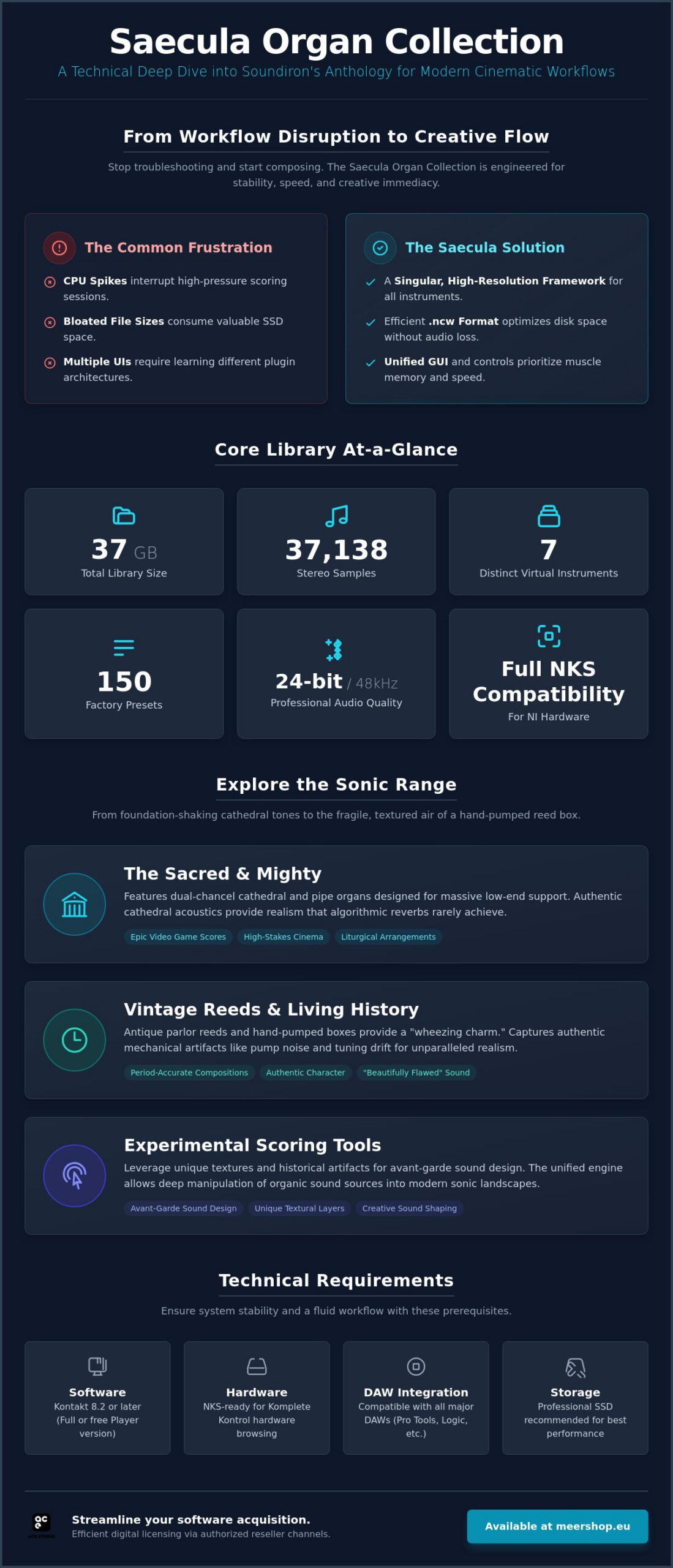
This professional reference guide provides a comprehensive technical breakdown of Soundiron’s anthology to help you evaluate its integration into your specific production environment. We will analyze how this 37 GB library consolidates seven distinct instruments into a singular, high-resolution framework. You will gain clarity on its 37,138 stereo samples, full NKS compatibility for Komplete Kontrol hardware, and the exact hardware specifications required to maintain a fluid workflow while accessing everything from liturgical pipes to vintage electric tones.
Key Takeaways
- Understand the functional scope of this anthology, which categorizes over 37,000 samples into distinct liturgical, vintage, and experimental scoring tools.
- Evaluate the technical compatibility of the Saecula Organ Collection with Native Instruments hardware and major DAWs like Pro Tools Ultimate.
- Optimize your sound-shaping workflow using advanced Kontakt interface parameters and pre-mapped NKS controls for hardware-based browsing.
- Identify specific hardware prerequisites and software requirements, such as Kontakt 8.2 or later, to ensure system stability during high-track-count sessions.
- Streamline your software acquisition and digital licensing process through authorized reseller channels for efficient studio management.
Technical Overview of the Saecula Organ Collection
The Saecula Organ Collection functions as a specialized multi-instrument anthology. It documents the technical and acoustic evolution of the organ across several centuries. Rather than focusing on a single instrument, this library consolidates seven distinct virtual instruments into a unified production environment. The collection tracks the transition from traditional wind-blown pipes to the mid-century innovation of electric tone-wheels. Soundiron collaborated with expert engineers to capture these specific instruments in their original acoustic spaces, ensuring that the spatial characteristics of the recording environments are preserved within the samples.
For the professional composer, the primary value of this library lies in its unified graphical user interface (GUI). Managing diverse organ types often requires learning multiple plugin architectures, which can disrupt a fast-paced scoring session. The Saecula Organ Collection solves this by applying a consistent set of sound-shaping controls and performance parameters across its entire range. This design choice prioritizes efficiency and muscle memory, allowing users to move between sacred pipes and vintage electric tones without re-learning the interface logic.
The Anthology Concept: Sacred to Eccentric
The scope of this collection is intentionally broad. It includes massive dual-chancel cathedral organs alongside smaller, hand-pumped reed boxes. The curation process focused on selecting instruments that represent specific milestones in organ history. This approach results in a library that offers both “perfect” liturgical instruments and “beautifully flawed” historical pieces. The inclusion of mechanical artifacts, such as pump noise and natural tuning drift in the reed organs, provides an authentic character that is often lost in more clinical digital recreations. These eccentricities are essential for composers who require historical accuracy or unique textures for experimental sound design.
Core Library Architecture
The underlying architecture of the library is designed for high-resolution performance within the Kontakt engine. It consists of 37,138 stereo samples recorded at 24-bit / 48kHz. These samples are delivered in a locked .ncw format, which optimizes disk space without compromising audio fidelity. The 37 GB library is organized into a modular patch system that includes 150 factory presets. This structure allows for rapid browsing while maintaining the ability to deep-dive into specific sound-shaping parameters. Key architectural features include:
- High-Resolution Foundation: All 37,138 samples maintain professional-grade 24-bit resolution.
- Modular Patches: Users can access 150 presets designed for immediate use in cinematic or liturgical contexts.
- Unified Controls: Every instrument in the collection shares the same core sound-shaping engine for consistent workflow.
- Efficient Formatting: The use of the .ncw format ensures that the 36.9 GB installation remains manageable on professional SSDs.
Exploring the Sonic Range: From Sacred Pipes to Electric Tone-Wheels
Composers require a clear technical framework when selecting which patch to load for a specific project. The Saecula Organ Collection organizes its seven instruments into three functional categories: Sacred & Mighty, Vintage Charm, and Intimate Reeds. This categorization allows a sound designer to quickly distinguish between foundation-shaking cathedral tones and the fragile, textured air of a hand-pumped reed box. Each category serves a distinct purpose in the modern scoring workflow, ranging from liturgical realism to avant-garde sound design.
The Sacred & Mighty: Cathedral and Pipe Organs
The cornerstone of this section is the dual-chancel cathedral organ, designed to provide the massive low-end support necessary for epic video game scores and traditional liturgical arrangements. These samples deliver the thunderous resonance required for boss battles or high-stakes cinematic moments where a standard synthesizer lacks the necessary acoustic weight. The pipe organ sampling technique utilized phased microphone arrays in fixed positions to capture the authentic acoustic interaction between the pipes and the cathedral’s physical architecture. This ensures that the natural reverberation and spatial positioning are baked into the samples, providing a level of realism that algorithmic reverbs rarely achieve.
Vintage Reeds and Living History
Shifting toward historical and period-accurate compositions, the library includes antique parlor reeds and hand-pumped boxes. These instruments provide a “wheezing charm,” characterized by mechanical artifacts and air-pressure fluctuations that add a human, organic layer to modern scores. Specific instruments like the Alpha Organ offer a delicate, breathy quality ideal for intimate dramas or folk-influenced soundtracks. When integrating these textures into a professional template, sourcing the Saecula Organ Collection through a reliable distributor ensures immediate access to these diverse sonic profiles for time-sensitive projects. The natural imperfections in these reed instruments act as a counterpoint to the clinical precision of modern digital tools.
Electric Tone-Wheels and Hybrid Consoles
The introduction of electricity into organ design marked a significant shift in the instrument’s evolution. This collection includes beautifully flawed electric organs that capture the transition from air-driven pipes to tone-wheel synthesis. The Trinity Electric Pipe Organ serves as a technical bridge, combining the mechanical nature of pipes with mid-century electrical switching. These hybrid consoles are particularly effective for horror scores or experimental tracks where a slightly “unstable” sound is desired. By documenting the role of electricity in these instruments, the library provides a comprehensive history of organ evolution, moving beyond traditional church sounds into the gritty, saturated tones of the electric era.
Performance Features and NKS Integration for Professionals
The utility of a high-resolution library is often limited by its accessibility within a complex DAW environment. The Saecula Organ Collection addresses this by implementing full Native Kontrol Standard (NKS) integration. This technical framework allows professional users to bypass standard MIDI mapping procedures. Instead, the library provides pre-configured parameter assignments that communicate directly with hardware controllers. For engineers managing high track counts, this integration reduces the cognitive load associated with software-based menu diving.
Beyond standard playback, the library includes a robust DSP engine designed to transform traditional organ tones into modern cinematic textures. This is achieved through a combination of modular sound-shaping tools and a comprehensive FX rack. The inclusion of 150 factory presets ensures that users can quickly audition both traditional liturgical setups and heavily processed hybrid patches. These “Custom FX” presets are particularly useful for sound designers who need to move beyond the historical accuracy discussed in previous sections and into the territory of avant-garde scoring.
NKS Workflow and Hardware Control
NKS compatibility offers a significant efficiency gain for users of Komplete Kontrol and S-Series keyboard controllers. The hardware automatically maps critical parameters like drawbars, swell pedals, and filter cutoffs to physical encoders. One of the most practical benefits is the light-guide integration. Because the Saecula Organ Collection contains instruments with varying physical key ranges, from massive cathedral consoles to small reed boxes, the light-guide provides immediate visual feedback on the active key zones and articulation triggers. Non-NKS libraries often require the composer to reference the software GUI to identify these boundaries; this hardware-level feedback keeps the focus on the performance rather than the monitor.
Advanced Sound Shaping and DSP
The Kontakt interface for this collection provides deep control over the underlying sample data. Every patch includes dedicated LFO, filter, and envelope controls, allowing for precise modulation of the organ’s sustain and decay. A specialized “Glitch” module is included for creating stutter effects and rhythmic artifacts, which is essential for modern horror or thriller scores. Additionally, the library features an integrated convolution reverb engine. This module includes a variety of impulse responses (IRs) from unique real-world spaces, ranging from tight wooden chambers to vast stone halls. These DSP tools allow a single pipe organ sample to be repurposed as a pad, a percussive texture, or a washed-out ambient drone without leaving the plugin interface.
- Tactile Browsing: Browse the 150 factory presets directly from hardware encoders.
- Visual Mapping: Identify articulation switches and playable ranges via LED light-guides.
- Rhythmic Manipulation: Use the Glitch module to deconstruct traditional tones into avant-garde textures.
- Spatial Precision: Apply specific convolution IRs to match the organ’s acoustic profile to your project’s environment.
Implementation and System Requirements for Modern DAWs
Adhering to specific hardware benchmarks is necessary to maintain studio stability when running high-resolution sample libraries. The Saecula Organ Collection requires a 64-bit environment and Kontakt version 8.2 or later. While the minimum system requirements specify a Dual Core CPU and 3 GB of RAM, professional scoring sessions often demand more robust hardware to handle the 37,138 stereo samples without latency. You must ensure your workstation runs Windows 7 or higher, or macOS 10.12 or higher, to remain compatible with the engine’s architecture.
Optimizing Performance in Large Templates
Managing a 36.9 GB installation within a massive orchestral template can tax your primary CPU resources. Many engineers utilize Vienna Ensemble Pro 8 to host the library outside the DAW process. This method allows for better RAM management and prevents the DAW from crashing during heavy project loads. Because pipe organ performances often involve high voice counts and long release tails, hosting the samples on a dedicated SATA or NVMe SSD is mandatory to prevent disk-streaming bottlenecks. If you’re layering multiple organ types alongside a full cinematic orchestra — such as the Eastwest Hollywood Orchestra Opus Edition — monitor your RAM usage closely; 16 GB or more is recommended for fluid multi-instrument performance.
DAW Integration and Compatibility
The library provides full compatibility with AAX, VST, and AU formats. This ensures a seamless setup within professional environments like Pro Tools Ultimate, Logic Pro, and Cubase. While many composers initially explore stock plugin options for basic keyboard sounds, those built-in tools typically lack the multi-mic perspectives and mechanical artifacts found in this anthology. Automation is a core feature; every internal parameter, including the swell pedal and filter cutoffs, is exposed for precise DAW-level control. This allows for dynamic performances that respond accurately to your project’s expression maps.
One significant advantage for studio owners is that this collection is licensed for the free Kontakt Player. You don’t need to own the full version of Kontakt to access the complete feature set or NKS integration. This lowers the entry barrier for secondary workstations or mobile scoring rigs. To integrate these historical textures into your current project, you can acquire the Saecula Organ Collection through our streamlined digital delivery system. Managing the library through Native Access ensures that updates and license migrations remain centralized and efficient.
Licensing and Acquisition via Meershop
Procuring professional software for a scoring stage or commercial studio involves more than a simple transaction. It requires administrative clarity and technical reliability to ensure that digital assets are properly licensed and supported. Meershop acts as an authorized reseller for the Saecula Organ Collection, providing a localized bridge for audio professionals in the Benelux region. Unlike direct manufacturer sales that may lack European-specific business support, Meershop ensures that the acquisition process aligns with professional accounting and studio management requirements.
The transition from evaluating a library’s technical specs to full studio implementation is managed through a streamlined digital delivery system. This process eliminates the logistical delays associated with international procurement. By positioning itself as an expert facilitator, Meershop allows composers to focus on their creative output while the brand handles the administrative nuances of software licensing and delivery.
Professional Licensing and VAT Compliance
For registered businesses, VAT compliance and transparent invoicing are essential for managing studio overhead. Meershop provides clear, business-professional documentation for every transaction, ensuring that your tax records remain accurate. This is particularly beneficial when you’re managing multiple licenses across different workstations or mobile scoring rigs. If you’re building a comprehensive production toolkit, you can consolidate your procurement by adding the Sonnox Vocal Production Bundle or other high-end processing tools to the same order. This centralized approach simplifies digital asset management for lead engineers and studio owners.
Support and After-Sales Service
Digital delivery for the Saecula Organ Collection is fast and secure. Once your purchase is finalized, you receive a license code for registration through Native Access. This ensures that your software remains up to date and easily migratable if you upgrade your hardware workstation. Meershop’s commitment to technical reliability means that support for registration or activation issues is handled by professionals who understand the Kontakt ecosystem. If you encounter a bottleneck during the 36.9 GB installation or NKS setup, you have access to a support channel that respects your production deadlines.
Reliable tools are the foundation of a professional workflow. Whether you’re integrating the historical pipes of the Saecula Organ Collection or exploring the synthesis history in Vintage Vault UVI, the goal is efficiency. Meershop eliminates the friction of international software procurement. By choosing an authorized reseller with specialized authority in the audio industry, you ensure that your studio’s software infrastructure is as stable as your hardware signal chain. A robust approach to audio software license management is equally critical to that stability, ensuring that your tools remain accessible and properly authorized across every workstation in your studio.
Elevate Your Scoring Workflow with Historical Authenticity
Integrating the Saecula Organ Collection into your template provides more than just a diverse sound set; it offers a technically optimized environment for both traditional and experimental scoring. You’ve seen how the library bridges the gap between massive cathedral pipes and mid-century electric consoles while maintaining full NKS compatibility for hardware-based control. By adhering to the system requirements and optimization strategies discussed, you can ensure these high-resolution samples perform reliably in high-track-count sessions without taxing your CPU unnecessarily.
As an authorized Soundiron reseller, Meershop facilitates this transition with instant digital delivery and expert technical support tailored for audio professionals. This localized approach ensures your studio management remains efficient and your licensing is fully compliant. It’s our goal to provide the tools you need without the distraction of marketing fluff.
Purchase the Saecula Organ Collection at Meershop to begin implementing these historical textures into your next project. We’re ready to help you expand your sonic palette with professional-grade instruments that respect your technical standards.
Frequently Asked Questions
Do I need the full version of Kontakt to use the Saecula Organ Collection?
No, the library is licensed for use with both the free Kontakt Player and the full version of Kontakt. You must ensure your software is updated to version 8.2 or later for full compatibility. This allows you to access the complete feature set and NKS integration without purchasing additional software from Native Instruments.
Is the Saecula Organ Collection compatible with NKS hardware?
Yes, the collection features full NKS integration for Native Instruments hardware. This includes pre-mapped parameters for Komplete Kontrol and S-Series keyboards, as well as light-guide support for identifying key ranges and articulation triggers. These hardware-level controls streamline the browsing and performance process in professional studio environments.
What is the total download size of the Saecula Organ Collection?
The total download size is 37 GB. Once installed, the library occupies 36.9 GB of disk space. Because of the high sample count, we recommend installing the Saecula Organ Collection on a dedicated SATA or NVMe SSD to ensure optimal streaming performance during high-voice-count arrangements.
Can I use these organ samples in commercial film and game scoring?
Yes, the license granted with your purchase covers commercial use in music production, film scoring, and game development. There are no additional royalty fees required for projects utilizing these samples. This makes the library a reliable asset for professional composers working on commercial contracts and high-stakes media projects.
How does the Saecula Organ Collection handle CPU usage in busy arrangements?
CPU usage is managed through the use of locked .ncw sample compression and efficient script architecture within the Kontakt engine. While the library is high-resolution, the modular patch system allows you to load only the specific instruments you need for a track. For complex arrangements with long release tails, a Dual Core CPU is the minimum requirement, though 16 GB of RAM is preferred for template stability.
Does the library include traditional stop controls for the pipe organs?
No, the interface replaces traditional draw-stops with a unified set of sound-shaping parameters designed for modern production. This allows for precise control over filters, envelopes, and LFO modulations across all seven instruments. This design choice prioritizes workflow speed and technical flexibility over a literal recreation of a physical organ console.
What are the main differences between the pipe organs and the electric organs in this collection?
The pipe organs utilize traditional wind-blown pipes and were captured in large cathedral spaces to preserve natural acoustic resonance. In contrast, the electric organs focus on tone-wheel synthesis and mid-century circuitry, delivering a more saturated and vintage character. The Saecula Organ Collection bridges these two eras, providing tools for both liturgical realism and gritty, modern sound design.
YOU MIGHT ALSO LIKE