English
Essential Plugins for Live Sound: The Professional Engineer’s 2026 Guide
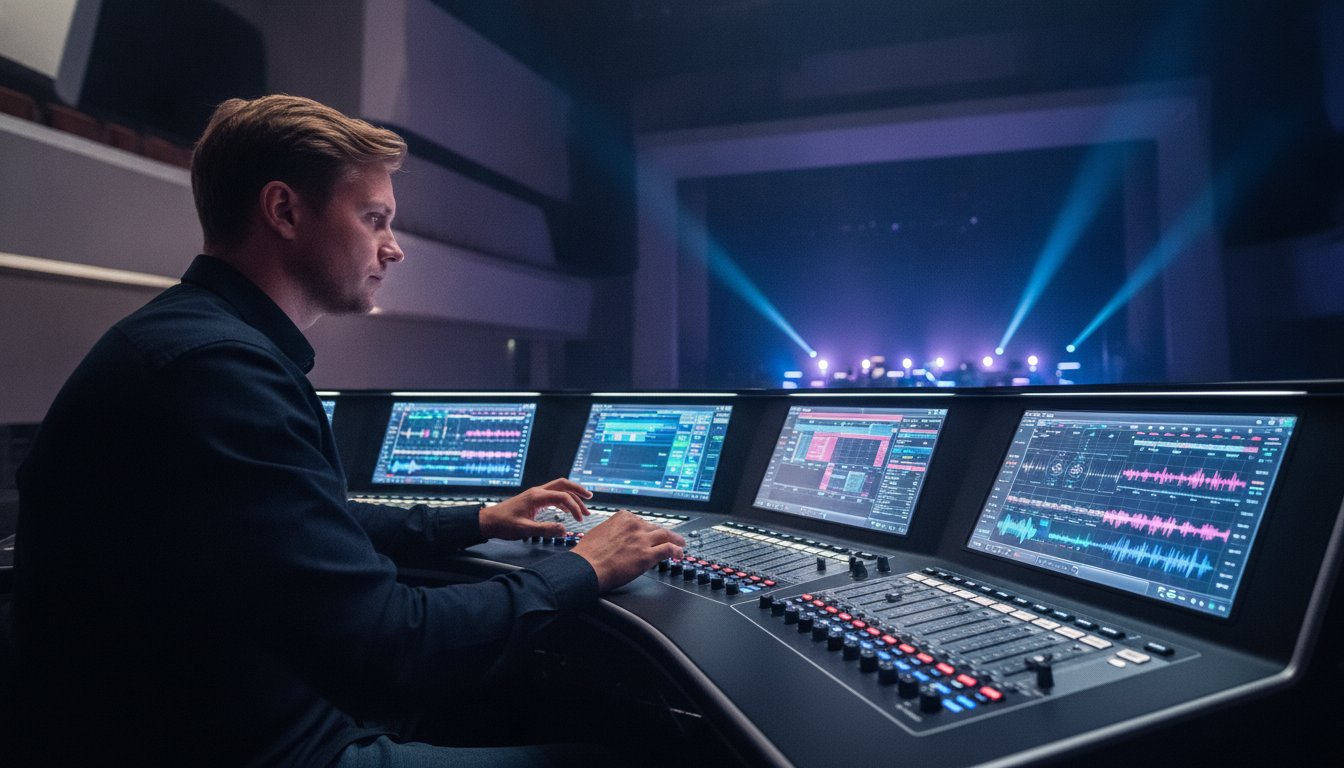
The 2026 Grammy Awards broadcast proved that immersive, software-driven mixing is no longer a luxury for the studio; it’s the new standard for the global stage. As a front-of-house or monitor engineer, you’ve probably faced the anxiety of potential system crashes or the timing issues caused by unpredictable audio latency. It’s a high-stakes environment where a single software conflict can disrupt an entire show. You need tools that offer more than just a specific color or character. You need a system that’s as stable as the hardware it replaces.
You can master the transition to software-based mixing with this expert guide to the most reliable, low-latency essential plugins for live sound. We’ll show you how to build a bulletproof plugin rack for touring and achieve studio-quality vocal and instrument processing in a live environment. We also break down the hardware requirements for software-based mixing, ensuring your host and console work in perfect sync. This guide focuses on the technical precision required to maintain a mission-critical signal path from soundcheck to the final encore.
Key Takeaways
- Identify the technical requirements for “live-ready” software, focusing on zero-latency processing and minimal CPU overhead to ensure mission-critical stability.
- Build a high-performance processing chain using essential plugins for live sound to address real-time acoustic challenges and achieve studio-grade vocal clarity.
- Evaluate the hardware infrastructure required for software-based mixing, including the integration of low-latency networking and platforms like the eMotion LV1 Classic.
- Streamline your touring workflow by implementing virtual soundchecks and snapshot automation to ensure consistent audio results across different venues.
- Understand why professional licensing and expert sourcing are critical for maintaining technical reliability and compliance during national and international tours.
Defining Essential Plugins for Live Sound in 2026
The live sound industry has moved past the era of heavy outboard racks. In 2026, the modern stage relies on integrated software ecosystems that provide the same sonic quality as studio environments but with the stability required for touring. Understanding what audio plugins are in a live context is the first step toward building a reliable rig. Unlike studio environments where you can freeze tracks or increase buffer sizes, the stage demands an instantaneous response. Identifying the essential plugins for live sound is about more than just tone; it’s about system integrity.
High-pressure touring environments expose the limitations of stock console plugins. While built-in tools are functional, they often lack the technical precision needed for complex acoustic environments. Selecting essential plugins for live sound requires a focus on two specific metrics: zero-latency processing and minimal CPU overhead. Meershop acts as an Expert Facilitator in this process. We ensure that the tools you choose are compatible with your hardware and stable enough for a rigorous tour schedule. This professional approach prioritizes reliability over creative experimentation.
Latency: The Silent Killer of Live Performance
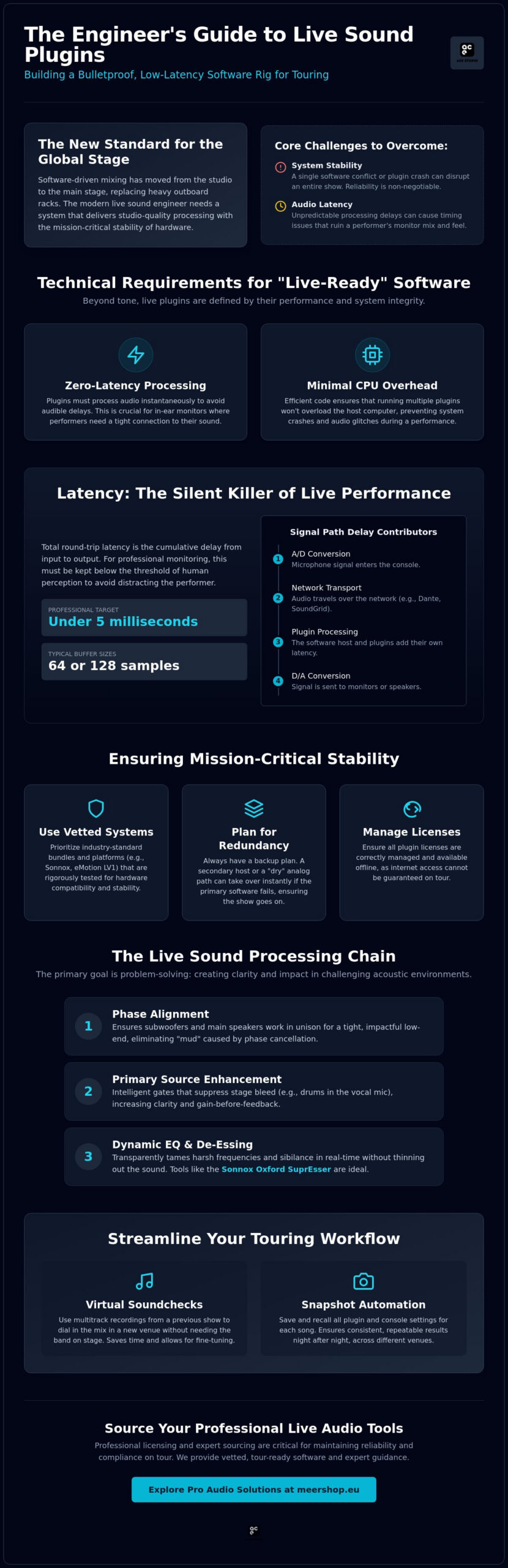
Total round-trip latency is the cumulative delay from the moment audio enters the console to the moment it reaches the performer’s ears. This calculation includes AD/DA conversion, network transport, and plugin processing cycles. Buffer sizes are the primary variable in this equation. If the buffer is too high, the performer feels a disconnect between their instrument and their monitor mix, which can ruin a performance. Most professional rigs target a buffer of 64 or 128 samples to maintain a tight feel. The industry-standard latency threshold for professional monitoring is generally accepted to be under 5 milliseconds to prevent phase issues or performance distraction.
Stability and Redundancy in Software Mixing
Stability is not negotiable when thousands of fans are in the audience. Professional engineers prioritize vetted, industry-standard bundles like the Sonnox Vocal Production Bundle or platforms like the eMotion LV1 Classic. These systems undergo rigorous testing for compatibility across specific hardware configurations. Experimental VSTs might offer unique textures in a studio, but they introduce a high risk of system crashes during a live show. Digital audio software licensing is another critical factor. Your licenses must be managed to ensure plugins remain active even if the rig lacks internet access for several weeks. A professional setup always includes a redundancy plan, such as a secondary host or a “dry” backup path that can take over immediately if the primary software host fails.
The Core Processing Chain: Must-Have Live Bundles
Building a processing chain for the stage requires a shift in mindset compared to studio work. Studio engineers often reach for character-heavy emulations to add warmth or grit. In a live environment, your primary goal is problem-solving. You need essential plugins for live sound that can handle high-gain-before-feedback scenarios and unpredictable room resonances. Utilizing advanced live sound processing techniques allows you to isolate the primary source, such as a lead vocal, from the stage bleed of drums or guitar amplifiers. This isolation is critical for maintaining a clean mix in reverberant spaces where every open microphone introduces potential mud.
Effective phase alignment and primary source enhancement are the foundations of a professional mix. If your low-end is muddy, it’s often a phase issue between the PA system and the stage monitors. Dedicated alignment tools ensure the subwoofers and mains work in unison, providing a tight, impactful low-end. Meanwhile, source enhancement plugins act as intelligent gates. They expand the dynamic range of a vocal while suppressing the ambient noise of a loud stage. This creates the headroom necessary for studio-quality clarity. Without these tools, you are constantly fighting the physical limitations of the venue rather than focusing on the artistic balance of the performance.
The Sonnox Advantage for Live Vocals
The Sonnox Vocal Production Bundle is a standard choice for engineers who prioritize transparency and speed. Tools like the Oxford SuprEsser provide dynamic frequency control to handle harshness and sibilance without the lisping effect common in cheaper de-essers. The Sonnox Oxford Dynamics remains a staple for transparent live compression because it offers surgical control over the knee and envelope. This high-fidelity approach is why Sonnox is preferred for major touring rigs where every nuance matters. It allows the engineer to maintain the natural character of the performer while controlling the dynamics in a high-pressure environment.
Dynamics and Frequency Management
Multiband compression acts as a Swiss Army Knife for the modern engineer. It allows you to correct instrument harshness in real-time without sacrificing the overall tonal character. While you might wonder if stock plugin capabilities are sufficient, professional third-party emulations offer superior algorithms and lower CPU overhead. These tools provide the stability needed to solve acoustic problems instantly. Integrating essential plugins for live sound into your workflow ensures that your mix remains consistent regardless of the venue size. A professional processing chain usually includes:
- Dynamic EQ: For frequency-specific resonance control that only activates when needed.
- Multiband Compression: To maintain tonal balance across the frequency spectrum.
- Primary Source Enhancement: To reduce stage bleed and increase gain-before-feedback.
- Precision Limiters: For system protection and final peak control.
If you are looking to upgrade your processing chain with vetted tools, you can find these industry-standard solutions in the Meershop software catalog.
Hosting and Platforms: The Infrastructure of Live Plugins
The shift toward software-first mixing consoles has fundamentally changed how engineers manage their signal path. Running essential plugins for live sound requires more than a standard laptop; it requires a dedicated host capable of managing high-bandwidth audio networking. A professional rig isn’t just a collection of VSTs. It’s a synchronized ecosystem where hardware and software work together to maintain zero-latency performance. Choosing the right infrastructure is as critical as choosing the plugins themselves. If the host fails or the network introduces jitter, the quality of the processing becomes irrelevant.
Networking protocols like SoundGrid and Dante dictate how audio moves through your system. SoundGrid remains the preferred choice for real-time plugin processing because it’s designed specifically for low-latency audio transport and DSP offloading. Dante is excellent for complex routing across large venues but often requires additional hardware interfaces to match the processing speed of a dedicated SoundGrid server. As discussed in recent research on Audio Signal Processing in the Artificial Intelligence Era, the industry is moving toward AI-driven error correction and predictive processing. These advancements will further stabilize software-based mixing, but they still require a robust hardware foundation to function in a live environment.
The eMotion LV1 Classic Ecosystem
The eMotion LV1 Classic serves as a primary host for live plugins, offering a bridge between software flexibility and hardware reliability. It allows engineers to integrate Waves and third-party processing directly into the console’s internal mixer. For touring professionals, the balance between tactile control and screen-based mixing is vital. The LV1 Classic provides physical faders and encoders, ensuring that you don’t have to rely solely on a mouse or touchscreen during a high-pressure show. This tactile integration is what makes it a “live-ready” platform compared to using a standard DAW on stage.
Vienna Ensemble Pro 8 as a Live Host
Managing high-track-count orchestral samples, such as the Eastwest Hollywood orchestra Opus Edition, demands significant CPU resources. Vienna Ensemble Pro 8 allows you to offload this VST instrument processing to secondary servers, keeping your main mixing host lean and stable. This setup is essential for keyboard rigs and large-scale productions where system crashes aren’t an option. By distributing the processing load, you ensure host stability during multi-hour performances. This infrastructure allows you to run essential plugins for live sound alongside massive sample libraries without compromising the integrity of the monitor or front-of-house mix.
Advanced Implementation: From Virtual Soundcheck to Show
Virtual soundcheck has transformed the daily routine of the touring engineer. By routing multi-track recordings back through the console, you can refine your essential plugins for live sound without requiring the performers on stage. This process is vital for dialing in complex dynamic EQ settings and multiband compression in a new acoustic environment. It ensures that the first note of the show is sonically consistent with the previous night’s performance. You can spend more time focusing on the nuances of the room’s acoustics rather than basic gain staging.
Automating snapshots for each song in the setlist allows you to change plugin parameters instantly. This ensures that a delay throw or a specific vocal character is exactly where it needs to be for every moment of the performance. You can automate bypass states, gain levels, and even specific plugin presets to match the arrangement of each track. Recording these shows also provides a valuable archive for future mix adjustments or promotional releases. This data is essential for reviewing the performance and making technical improvements for the next leg of the tour.
Pro Tools Ultimate in the Live Environment
Pro Tools Ultimate serves as the industry-standard engine for high-track-count live recording and playback. In a live rig, it allows for a seamless transition between ‘Live’ and ‘Playback’ modes. This means you can record the soundcheck and immediately play it back through the same channel strips to adjust your essential plugins for live sound. Maintaining standardized session templates ensures consistency throughout a national tour. It allows any engineer on the crew to troubleshoot the signal path quickly if a technical issue arises.
Optimizing Your Plugin Rack for CPU Efficiency
Managing DSP resources is a critical task during a multi-hour show. CPU spikes often occur during peak transients or when large snapshots are triggered simultaneously. You must distinguish between bypassing and deactivating a plugin. Bypassing keeps the plugin active in the background, consuming CPU but allowing for instant engagement. Deactivating completely removes the processing load, which is necessary for managing ‘heavy’ plugins that threaten system stability. These heavy processors often include convolution reverbs or complex linear-phase EQs. Dedicated DSP servers offload the computational burden from the host computer to ensure a stable, low-latency signal path regardless of the plugin count.
Professional engineers who require mission-critical stability can purchase professional audio software licenses at Meershop to ensure their rigs are fully compliant and tour-ready.
Sourcing Professional Live Audio Tools with Meershop
Professional licensing is a matter of logistical security rather than just legal compliance. When you are touring across international borders, your software licenses must be manageable and reliable. Meershop serves as an Expert Facilitator for Dutch audio professionals, providing a direct link to the manufacturers of essential plugins for live sound. This specialized approach removes the uncertainty of digital licensing and ensures that your rig remains operational regardless of your location. Purchasing through a professional reseller guarantees that you have the administrative support necessary for high-stakes environments. We prioritize logistical clarity, helping you manage licensing tiers and delivery methods with clinical precision.
The transition to a software-based rig requires a partner that understands the technical nuances of the industry. Reliability is the primary metric for any touring engineer. By sourcing your tools from a specialized vendor, you ensure that every component of your signal path is vetted for professional use. This no-nonsense approach to procurement allows you to focus on the mix rather than troubleshooting licensing errors or software conflicts. We stay in the background, acting as a bridge between the manufacturer and the end-user to facilitate a seamless technical workflow.
Authorized Reselling and Technical Support
Gray-market licenses pose a significant threat to professional stability. These licenses often lack proper support or fail during critical software updates, which can be catastrophic during a tour. Meershop focuses on utilitarian and transparent audio solutions, ensuring that your eMotion LV1 Classic hardware is fully compatible with your chosen plugin bundles. This technical synergy prevents the configuration errors that lead to system crashes. Our role is to provide the technical precision needed to maintain a professional mixing environment. We avoid unnecessary marketing fluff, focusing instead on the technical facts that matter to an engineer behind the console.
Building Your 2026 Touring Rig
Your choice of processing tools should reflect the specific requirements of your production. Pop tours often require the transparent dynamics of the Sonnox Vocal Production Bundle to manage high-gain vocals. Orchestral productions, however, benefit from the resource management of Vienna Ensemble Pro 8 to handle high-track counts. For specialized live venues, integrating the Saecula Organ Collection provides authentic textures that stock samples cannot replicate. You can also access comprehensive sound libraries like Vintage Vault UVI to expand your sonic palette for live performance. Selecting the right essential plugins for live sound is the final step in creating a bulletproof system. Our methodical approach ensures that every piece of information is presented with meticulous attention to detail. To begin finalizing your technical setup, you should explore the Meershop catalog for your next tour.
Securing Your Technical Future on the Modern Stage
The move toward software-based mixing is a technical shift that demands precision and the correct infrastructure. You’ve learned how zero-latency processing and dedicated hosts like the eMotion LV1 Classic form the foundation of a stable touring rig. By prioritizing essential plugins for live sound from vetted developers, you ensure your mix remains consistent across different acoustic environments. Professional licensing provides the administrative security needed for national and international tours, preventing software failures at critical moments.
Meershop acts as your Expert Facilitator in this technical landscape. We are an authorized reseller of Waves, Sonnox, and the Vienna Symphonic Library, with a specific focus on eMotion LV1 Classic configurations. Our team provides specialized Dutch support for audio professionals who require utilitarian and transparent solutions. Upgrade your live rig with professional plugins and hardware at Meershop to ensure your setup is mission-critical and tour-ready. You are now equipped to achieve studio-quality clarity in any live environment.
Frequently Asked Questions
Are Waves plugins the only option for live sound?
No, Waves is not the only option, although it remains a dominant standard due to the SoundGrid ecosystem. Many professional engineers integrate third-party tools like the Sonnox Vocal Production Bundle to achieve specific sonic results. The key is ensuring that any non-Waves plugin is compatible with your hosting platform and meets the zero-latency requirements for live performance. Professional rigs often combine several developers to build a comprehensive processing chain.
How do I minimize latency when using VST plugins on stage?
You minimize latency by using dedicated DSP hardware and optimizing your host’s buffer settings. Setting your buffer to 64 or 128 samples is standard for professional monitoring. Offloading the processing to an external server ensures that the round-trip delay stays below the 5-millisecond threshold, which is critical for performer timing. This hardware-software synergy prevents the phase issues that occur when software processing is too slow for the stage.
Can I use studio plugins like the Sonnox Vocal Bundle for live mixing?
Yes, you can use the Sonnox Vocal Production Bundle for live mixing if your host supports the VST or SoundGrid versions. These plugins are highly valued for their transparency and surgical precision. Using essential plugins for live sound that originated in the studio allows you to maintain high-fidelity audio quality while solving real-time acoustic issues like sibilance and harshness. This approach ensures your live mix matches the quality of a studio production.
What hardware is required to run the eMotion LV1 Classic?
The eMotion LV1 Classic requires a SoundGrid-compatible DSP server, a qualified network switch, and at least one SoundGrid I/O interface. You also need a host computer or a dedicated touch-screen console to run the software. This hardware combination creates a synchronized environment that handles high-bandwidth audio networking with mission-critical stability. It ensures that your processing rack remains responsive and reliable during a rigorous tour schedule.
Is it better to buy perpetual licenses or subscriptions for live audio software?
Perpetual licenses are generally preferred for touring because they don’t require an active internet connection to verify your status during a show. While subscriptions offer access to more tools, a perpetual license ensures that your essential plugins for live sound remain active in remote venues. This stability is vital for maintaining a consistent signal path throughout a national tour. It eliminates the risk of a license lockout during a performance.
How do I handle a plugin crash during a live performance?
You handle a plugin crash by having a pre-configured dry backup path or a redundant secondary host. Most professional consoles allow you to bypass the software rack instantly if a failure occurs. Regularly vetting your plugin list and avoiding experimental VSTs reduces the risk of these crashes. A professional redundancy plan ensures the audience never hears a technical interruption, even if the primary host computer requires a reboot.
What is the difference between a DSP-based and a Native-based live rig?
A DSP-based rig uses external hardware servers to process audio, which guarantees lower latency and higher stability. Native-based rigs rely on the host computer’s CPU, which can be prone to spikes during peak transients. For high-pressure touring, DSP-based systems are the industry standard because they protect the mix from the unpredictable performance of a standard operating system. This separation of tasks ensures the audio path remains uninterrupted.
Does Vienna Ensemble Pro 8 work for live keyboardists?
Vienna Ensemble Pro 8 is an excellent tool for live keyboardists who need to manage massive sample libraries like the Eastwest Hollywood orchestra Opus Edition. It allows you to host virtual instruments on a separate computer, offloading the CPU burden from your main performance laptop. This setup ensures that your keyboard sounds remain glitch-free and responsive during a multi-hour show. It provides the stability needed for complex orchestral arrangements on stage.