Nederlands
EMotion LV1 Classic: The Definitive Buying Guide for Live Sound Engineers
Could a software-driven engine truly replace the tactile reliability of a traditional touring desk? For years, live engineers have balanced the desire for studio-grade Waves processing against the very real fears of software latency and complex networking. You know that the high-stakes pressure of a live environment doesn’t allow for stability issues or the frustration of a touchscreen-only interface when you need a physical fader. The eMotion LV1 Classic addresses these specific pain points by merging a software engine with a ruggedized, 17-fader hardware surface.
This definitive guide demonstrates how this console bridges the gap, integrating a high-performance Waves engine within a dedicated, professional hardware console built for the road. You’ll discover how to achieve a reliable, studio-quality mix with a compact footprint that doesn’t compromise on your channel count. We’ll examine the technical specifications, the seamless SoundGrid integration, and the exact steps to transition your workflow from analog logic to this modern hybrid powerhouse. Whether you’re managing 64 stereo channels or scaling up to an 80-channel configuration, the goal is a seamless, professional mix every night.
Key Takeaways
- Understand the technical advantages of the double-precision 32-bit float mix engine for achieving studio-grade audio quality in live environments.
- Evaluate the standard I/O configuration and learn how to scale your system up to 80 stereo channels through software-based expansion.
- Discover how to integrate SoundGrid-compatible stageboxes like the IONIC 16 and 24 to customize your input and output capacity.
- Master the hybrid workflow that combines 17 motorized faders with a multi-touch interface for high-speed adjustments during live performances.
- Learn why sourcing your eMotion LV1 Classic from a specialized reseller like Meershop provides essential pre-sales and post-sales technical support.
Understanding the eMotion LV1 Classic: A Hardware-Software Hybrid
The eMotion LV1 Classic represents a significant shift in the evolution of professional live sound environments. Traditionally, engineers seeking Waves processing on stage had to assemble modular systems consisting of separate servers, screens, and third-party controllers. This consolidated console changes that approach. It integrates the proven LV1 software engine into a purpose-built hardware frame, providing a stable and predictable environment for high-stakes mixing. By housing the processing, I/O, and control surface in a single chassis, it removes the variables often associated with custom-built rigs.
At the heart of the system is a double-precision 32-bit float mix engine. This architecture provides the necessary headroom and sonic clarity required for modern high-fidelity sound reinforcement. Understanding the Waves Audio history clarifies why this console exists; it’s the logical progression for a company that has defined studio processing for decades. The console features a large 21.5-inch HD multi-touch screen that serves as the central hub for the UI. This screen is bright enough for outdoor use and responsive enough for the rapid adjustments required during a live performance, eliminating the need for external monitors or cluttered cabling.
The Core LV1 Engine
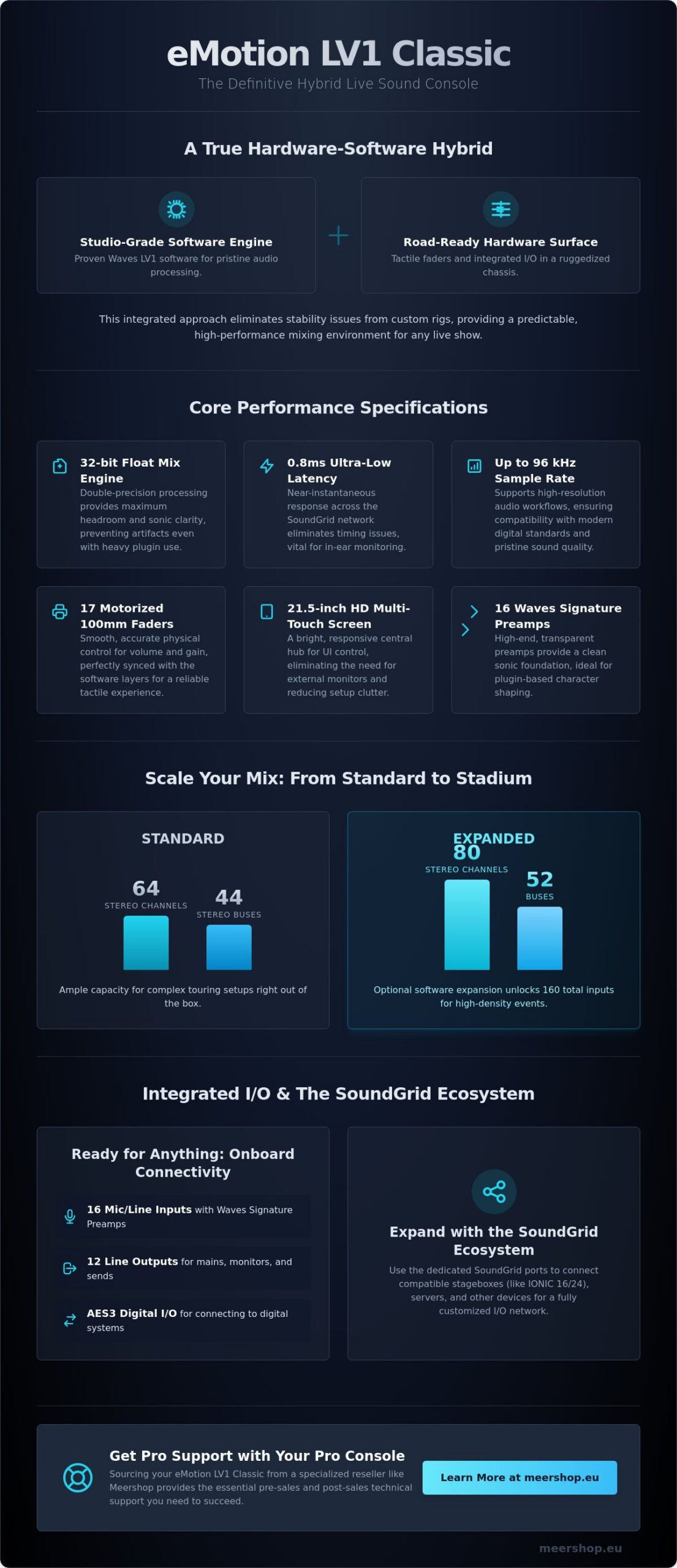
The console architecture supports 64 stereo input channels and 44 stereo buses, providing ample capacity for complex touring setups. It handles sample rates from 44.1 kHz up to 96 kHz, ensuring compatibility with various digital protocols and high-resolution audio requirements. One of the most critical metrics for live sound is speed. Within the SoundGrid network, this system achieves a latency of 0.8 ms. This near-instantaneous response is vital when performers are using in-ear monitors, as it prevents the distracting “comb filtering” effect caused by delayed signals. The 32-bit float engine ensures that even when multiple plugins are used across a channel strip, the internal summing remains precise and artifact-free.
Integrated Hardware Advantages
The eMotion LV1 Classic includes 16 onboard Waves Signature Preamps. these high-end preamps provide a transparent starting point for any mix, allowing the engineer to use plugins for character rather than corrective measures. Because the DSP is built directly into the console, there’s no need to transport separate server racks for standard operations. This integrated design makes it a practical choice for fly-dates and mobile setups. It weighs significantly less than traditional large-format consoles while maintaining a 17-fader physical layout. This tactile control is essential for engineers who prefer the feel of motorized 100mm faders for volume and gain adjustments while using the touchscreen for deeper channel parameters and routing.
Key Performance Specifications and Comparison
The physical layout of the eMotion LV1 Classic provides a deliberate balance between analog familiarity and digital efficiency. It features 16 onboard mic/line inputs equipped with Waves Signature Preamps and 12 line outputs. For digital expansion, the console includes AES3 I/O and dedicated SoundGrid ports. This configuration allows for immediate operation as a standalone unit while remaining ready for larger network integration. While the base model supports 64 stereo channels, engineers can scale their processing power through an optional 80-channel software expansion. This upgrade increases the capacity to 160 inputs and 52 buses, making it suitable for high-density touring requirements.
Input and Output Architecture
Managing complex stage setups requires precise control over signal groups. The console provides 8 Mute groups and 16 link DCAs, allowing for streamlined control over large drum kits or orchestral sections. The Waves Signature Preamps are designed for high-fidelity capture, offering a neutral sonic foundation that responds well to heavy plugin processing. This technical precision is one reason why the system is gaining traction in varied environments, as noted in this technical review of the eMotion LV1 Classic for Church Sound. For monitoring, the hardware includes dedicated headphone outputs and clear visual metering for every bus and channel.
Tactile feedback remains a priority for live mixing. The console is fitted with 17 motorized 100mm faders that offer smooth, accurate response for volume and gain adjustments. These faders integrate directly with the software layers, ensuring that physical positions always reflect the digital state of the mixer. This hardware-software synchronization eliminates the “parameter jump” issues often found in cheaper control surfaces.
LV1 Classic vs. Modular LV1 Rigs
Choosing the Classic model over a modular LV1 setup offers distinct logistical advantages. A modular rig requires a separate DSP server, a computer, multiple touchscreens, and a third-party fader bank. The eMotion LV1 Classic consolidates these components into a single, manufacturer-tested housing. This integration significantly reduces setup time for touring engineers who need to be ready for soundcheck within minutes of arrival. Rental houses also benefit from the reduced complexity, as there are fewer cables and connectors that could fail during transport or operation.
Reliability is often the deciding factor in professional environments. By using a unified hardware platform, you eliminate the compatibility risks associated with mixing different brands of screens and controllers. If you are looking to simplify your touring inventory, you can view the full technical specifications to see how this console fits your existing infrastructure. The internal DSP provides the same low-latency performance as external SoundGrid servers but within a more rugged and portable frame.
The SoundGrid Ecosystem: Preamps, Stageboxes, and DSP
The eMotion LV1 Classic serves as the operational hub for a larger SoundGrid network. It isn’t limited to its internal I/O. This scalability is achieved through the SoundGrid protocol, which allows for low-latency audio distribution over standard Ethernet infrastructure. You can network multiple consoles together for Front of House and Monitor splits, allowing two engineers to share the same stage inputs while maintaining independent mix control and processing. This networked approach eliminates the need for expensive and heavy analog splitters.
In ALIA’s review of the LV1 Classic, the hardware-software hybrid nature is praised for its ability to handle complex routing without the bulk of traditional setups. To manage these splits effectively, a certified SoundGrid switch acts as the traffic controller for the high-bandwidth audio data moving between the stage and the mix positions. This ensures that every signal arrives at its destination with a latency of 0.8 ms or less, regardless of the network’s size.
Expanding with IONIC Stageboxes
The IONIC 16 and IONIC 24 stageboxes are designed specifically to complement the eMotion LV1 Classic. These units feature the same high-headroom Waves Signature Preamps found in the console hardware. Connecting these stageboxes requires only standard Cat5e or Cat6 cabling, which simplifies long-distance signal transmission. In a networked environment, gain sharing becomes a critical consideration. The LV1 software allows for precise digital gain control and compensation. This ensures that adjustments at FOH don’t inadvertently ruin the gain structure for the monitor engineer. Key advantages of this expansion include:
- Direct Integration: Preamps are controlled directly from the console’s channel strips.
- Simplified Cabling: Ethernet replaces heavy copper snakes for cleaner stage setups.
- High Fidelity: Professional-grade conversion maintains signal integrity from the stage to the mix engine.
DSP and Plugin Processing
The console’s internal processing is powerful enough to run the 16 included Waves plugins across multiple channels. However, as the production grows and you integrate third-party tools like the Sonnox Vocal Production Bundle, you might need additional processing power. External SoundGrid DSP servers can be added to the network to offload these intensive tasks. This modular approach to DSP allows you to scale the processing power based on the specific needs of the show without replacing the console itself.
The UI provides real-time CPU load monitoring. It’s easy to see when a plugin should be moved to an external server to maintain system stability. By managing the load across both internal and external servers, you ensure the mix engine remains responsive even under heavy processing demands. This flexibility is essential for engineers who want to bring studio-quality processing to the stage without risking software crashes or audio dropouts.
Optimizing Workflow with Tactile Control and Touch
Transitioning from a mouse-and-screen setup to the eMotion LV1 Classic changes how you interact with a live mix. The hardware eliminates the disconnect between seeing a parameter and adjusting it. You don’t have to hunt for a cursor during a performance. Instead, you use the 21.5-inch multi-touch screen for high-level navigation and the 17 motorized faders for precise level control. This synergy allows for a faster response to on-stage events. It brings the tactile reliability of a traditional desk to the flexible world of Waves software.
Tactile Fader Management
Managing a 64-channel mix within a compact footprint requires efficient layer management. The console allows you to map fader banks and create custom layers tailored to specific parts of the show. You can group all critical inputs, such as lead vocals and key instruments, onto a single top layer while keeping less frequent adjustments on secondary banks. The physical faders provide the resistance and feedback that software-only systems lack. This allows you to make adjustments by feel while keeping your eyes on the stage. 100mm motorized faders ensure that when you switch layers, the physical positions accurately reflect your digital gain structure.
The “Touch-and-Turn” workflow is a key efficiency booster. By selecting a parameter on the touchscreen, you can immediately assign it to a physical control for fine-tuning. This is particularly useful for EQ sweeps or dialing in compressor thresholds where a finger swipe on a screen might be too imprecise. If you want to experience this tactile response in your own touring setup, you can purchase the eMotion LV1 Classic directly from our specialized inventory for fast delivery within the Benelux region.
Screen Layout and Customization
The screen layout is fully customizable to suit your visual preferences. You can set up the mixer view to show wide channel strips for detailed metering or narrow strips to see more of the 64 channels simultaneously. Integrating plugin windows directly into the channel strip workflow means you don’t have to switch views to adjust your primary processing. The quick-access sidebars provide a permanent home for essential monitoring tools and bus masters, ensuring that your output levels are always visible regardless of which input layer is active.
Utilizing user-defined keys adds another layer of speed. These physical buttons can be programmed for instant access to actions like tap tempo, scene recall, or mute group activation. By offloading these frequent tasks to dedicated hardware buttons, you keep the touchscreen clear for more complex routing and plugin management. This methodical approach to customization ensures that even the most complex productions remain manageable under the high-pressure environment of a live show.
Purchasing the eMotion LV1 Classic: Why Meershop?
Selecting high-end audio hardware like the eMotion LV1 Classic requires more than just a standard e-commerce transaction. It’s a professional investment that demands specialized technical oversight. Meershop operates as a dedicated resource for the Benelux and national markets, providing the administrative and technical clarity essential for audio professionals. We act as a bridge between the manufacturer and the end-user. This ensures that your hardware is correctly registered and your software environment is ready for immediate deployment from day one.
Expert Facilitation and Support
Technical compatibility is often the most significant hurdle when integrating a new console into an existing infrastructure. Our specialists provide direct pre-sales consultation to verify that your SoundGrid network and I/O requirements are fully met. This includes advice on integrating specific software bundles like the Sonnox Vocal Production Bundle or the Eastwest Hollywood orchestra Opus Edition into your workflow. You won’t find this level of specialized authority at generic retailers.
We provide direct communication channels for post-sales troubleshooting. If you encounter issues during the initial SoundGrid setup or Waves plugin registration, our team offers instructional support to resolve technical queries quickly. This methodical approach minimizes downtime. It ensures that your system performs reliably from the very first soundcheck. We respect your time and expertise by focusing on the technical facts you need to stay operational.
Licensing and Warranty
Every eMotion LV1 Classic purchase includes a 1-year Waves Update Plan (WUP). This plan ensures your software remains compatible with the latest operating systems and provides access to new features as they are released. Managing these licenses is done through the Waves Central application. We assist with this process to ensure all 16 included Waves processors are active and correctly licensed to your hardware. This administrative support is a core part of our commitment to professional service.
Reliable national delivery is a priority for high-end gear. We handle the logistics with meticulous attention to detail, ensuring your console arrives safely and on schedule. Beyond the hardware, we also offer access to essential software tools like Vienna Ensemble Pro 8 and Pro Tools Ultimate 1 Year Subscriptions to complete your professional environment. Our focus remains on the utility of the products and the efficiency of the transaction, positioning Meershop as a stable partner in a niche market.
Future-Proof Your Live Mixing Infrastructure
The shift toward a hardware-software hybrid model provides the stability of a physical console with the flexibility of studio-grade processing. The eMotion LV1 Classic consolidates the power of the Waves engine into a rugged, touring-ready frame, effectively eliminating the variables associated with modular rigs. By integrating physical motorized faders with a high-resolution touch interface, you maintain the tactile control necessary for precise adjustments in high-pressure environments. This console ensures your workflow remains efficient as production demands scale through the SoundGrid ecosystem.
Meershop supports your transition to this modern standard with specialized reseller expertise and official Waves reseller status. We understand the technical nuances of digital licensing and hardware integration. Our team provides direct specialist support via phone or email to ensure your system is configured correctly from the first soundcheck. You don’t have to manage complex networking alone. Order the eMotion LV1 Classic from Meershop today and experience the reliability of a professional partner. Elevate your touring standards with a console built for the future of live sound.
Frequently Asked Questions
Does the eMotion LV1 Classic come with plugins included?
The eMotion LV1 Classic comes with 16 Waves processors included as standard. These tools allow you to manage essential dynamics and frequency adjustments right out of the box. While the console is ready for immediate use, you can also integrate larger bundles if your production requires more specialized processing. It’s a versatile starting point for any professional engineer.
Can I expand the channel count beyond the standard 64 channels?
You can expand the channel count beyond the standard 64 stereo channels via a software upgrade. This optional expansion increases the capacity to 80 stereo channels and 52 buses. It’s a digital process that doesn’t require physical hardware changes. This allows you to scale your system as your production requirements grow without needing to invest in a completely new console.
What are the minimum network requirements for the SoundGrid ecosystem?
SoundGrid networks require at least Cat5e or Cat6 cabling for reliable data transmission. It’s also essential to use a certified SoundGrid network switch to manage the audio traffic. Using non-certified hardware can lead to synchronization issues or increased latency. Following these requirements ensures you maintain the industry-leading 0.8 ms latency across your entire stage and FOH network.
Is an external DSP server required for the LV1 Classic to function?
An external DSP server isn’t required for the console to function. The hardware includes an internal processing engine capable of running the 64-channel mixer and the 16 included plugins. However, if you intend to use a high density of third-party plugins or complex Waves chains, adding an external SoundGrid server can offload that processing to maintain system stability.
Can I use third-party VST plugins with the eMotion LV1 Classic?
You can only use third-party plugins that are specifically SoundGrid-compatible. Developers such as Sonnox and Flux provide plugins that run on the SoundGrid DSP, allowing them to function within the low-latency environment of the console. Standard VST plugins that haven’t been ported to the SoundGrid platform won’t work within the eMotion LV1 software engine.
What is the difference between the LV1 Classic and the modular LV1 software?
The main difference is that the Classic model is an all-in-one hardware solution, whereas the modular version requires separate components. In a modular setup, you must provide your own computer, DSP server, touchscreen, and fader controllers. The eMotion LV1 Classic consolidates all these elements into a single, manufacturer-tested chassis. This reduces cabling complexity and significantly speeds up your setup time at the venue.
How does the Waves Signature Preamp compare to other high-end live preamps?
The Waves Signature Preamps provide a transparent, high-headroom signal path that rivals many boutique live preamps. They are designed to be sonically neutral, which gives you a clean canvas for plugin processing. This transparency is vital for engineers who want their EQ and compression plugins to define the final sound rather than the preamp adding unwanted coloration.
Is the eMotion LV1 Classic suitable for permanent installations as well as touring?
The console is an excellent choice for permanent installations due to its compact footprint and high reliability. It fits easily into small control rooms or booths where space is at a premium. Because it’s a dedicated hardware unit rather than a custom-built PC, it offers a more stable and predictable environment for house engineers in theaters or houses of worship.